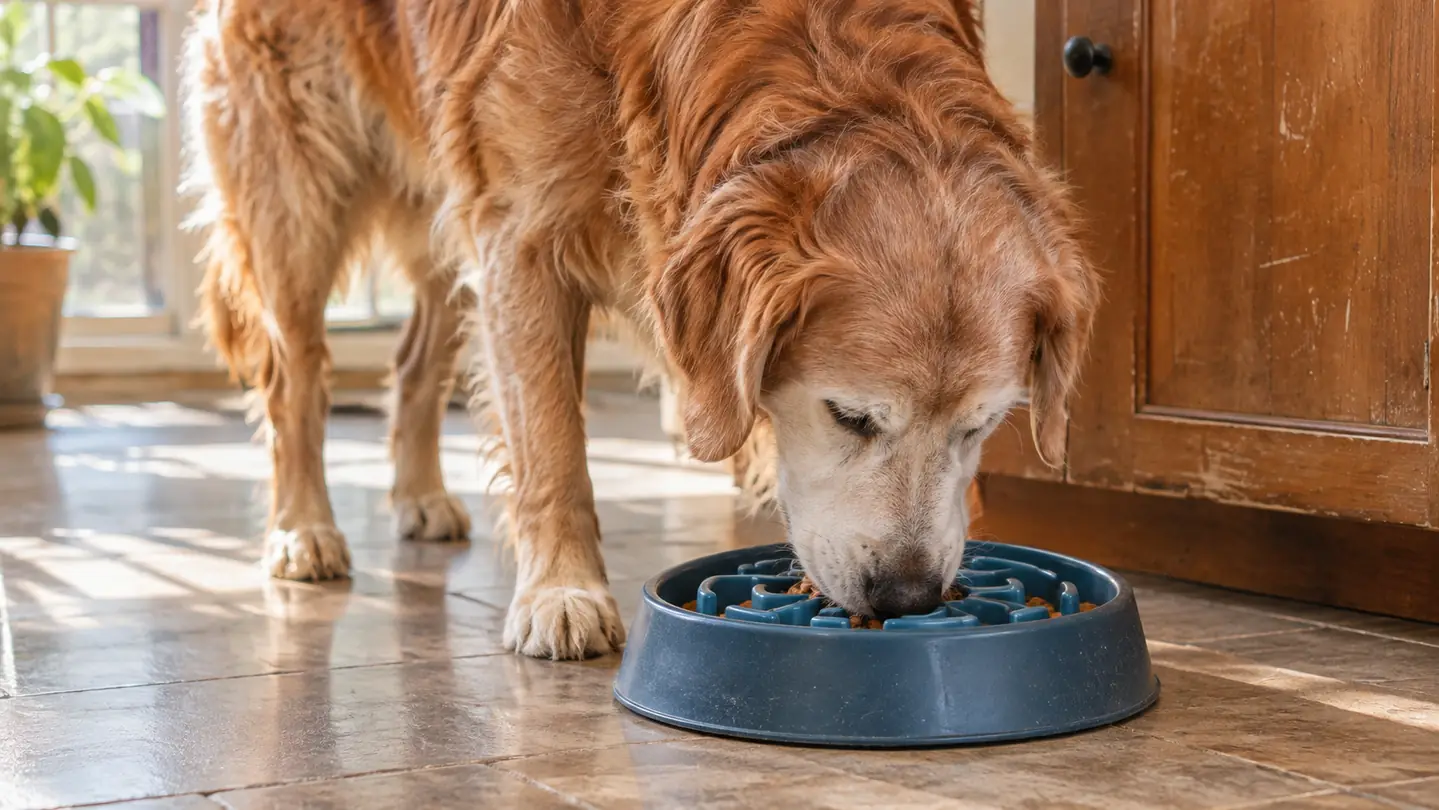
The first thing I noticed after I switched Juniper to the Outward Hound Fun Feeder was not the bowl at all. It was the quiet. For most of her life, dinner had lasted about forty seconds and sounded like a small engine starting up in the kitchen. Then it stretched to six or seven minutes, and the only noise was her nose working around the ridges and the tap of a collar tag against the floor.
I have had Juniper, a Golden Retriever who turned ten this fall, since she was eight weeks old. I started using this bowl in March 2024, so we are about two and a half years in, twice a day, every day. What follows is not a study of slow feeding and it is not veterinary advice. It is what I have learned about the three things nobody mentions when they hand you one of these: washing it, sizing it, and the way it behaves on a hard floor.
The Quick Verdict
It did the one job I bought it for. Dinner went from under a minute to several minutes, and Juniper has not brought a meal back up since. It is also a daily hand wash that slides across tile if you let it.
Amazon Check Today's Price →If dinner is over before you sit down, this is the bowl in my kitchen
Four cups, the Slowest maze pattern, about two and a half years of twice-daily use on a sixty-four pound Golden. Check the size and pattern on the listing before you pick, because the level matters more than the price.
Amazon Check Today's Price on Amazon →The Short Version, Before the Details
If you only want the summary: the Outward Hound Fun Feeder works, it has held up through two and a half years of daily use without a crack or a warp, and it is a mild annoyance to clean every single day. It is a plain plastic bowl with raised ridges and no moving parts, which is exactly why I chose it. What I would change is nothing about the bowl and everything about how the listing prepares you. Nobody warns you that a maze bowl full of kibble dust and dog saliva is a small scrubbing job, and nobody tells you that firing a two cup meal into a four cup bowl defeats the whole design.
What Nobody Tells You About Slow Feeders
A slow feeder does not change what your dog eats or how much. It changes the pace, and only the pace. I want to be clear about that because I have watched people buy one of these hoping it would take weight off a dog. It will not. What took the extra few pounds off Juniper was measuring her kibble with an actual cup and adding a second, slower walk in the evening. The bowl just stopped her from inhaling the measured amount in forty seconds.
The second thing nobody says is that the first week is a bad week. Juniper nosed at it, looked at me like I had made an error on her behalf, walked to the door, and came back to try again. She got maybe a third of her dinner that first night before she quit. I did not top the bowl up to make up for it. By the fourth day she had the geometry figured out and was eating normally, just slowly. If you panic and add a second bowl of loose kibble on the side, you have paid for a puzzle and taught your dog to wait you out.
The third thing is that this is not a medical answer to anything. I did not buy it because a vet pointed at it. I bought it because I was tired of mopping and tired of a dog who could not keep a meal down when she ate like a vacuum cleaner. If your dog is bringing food up several times a week, or losing weight, or seems uncomfortable after eating, that is a conversation with your own vet and a bowl is not going to be the answer. Slower eating helped my dog. That is a smaller claim than it sounds.
How I Have Actually Used It
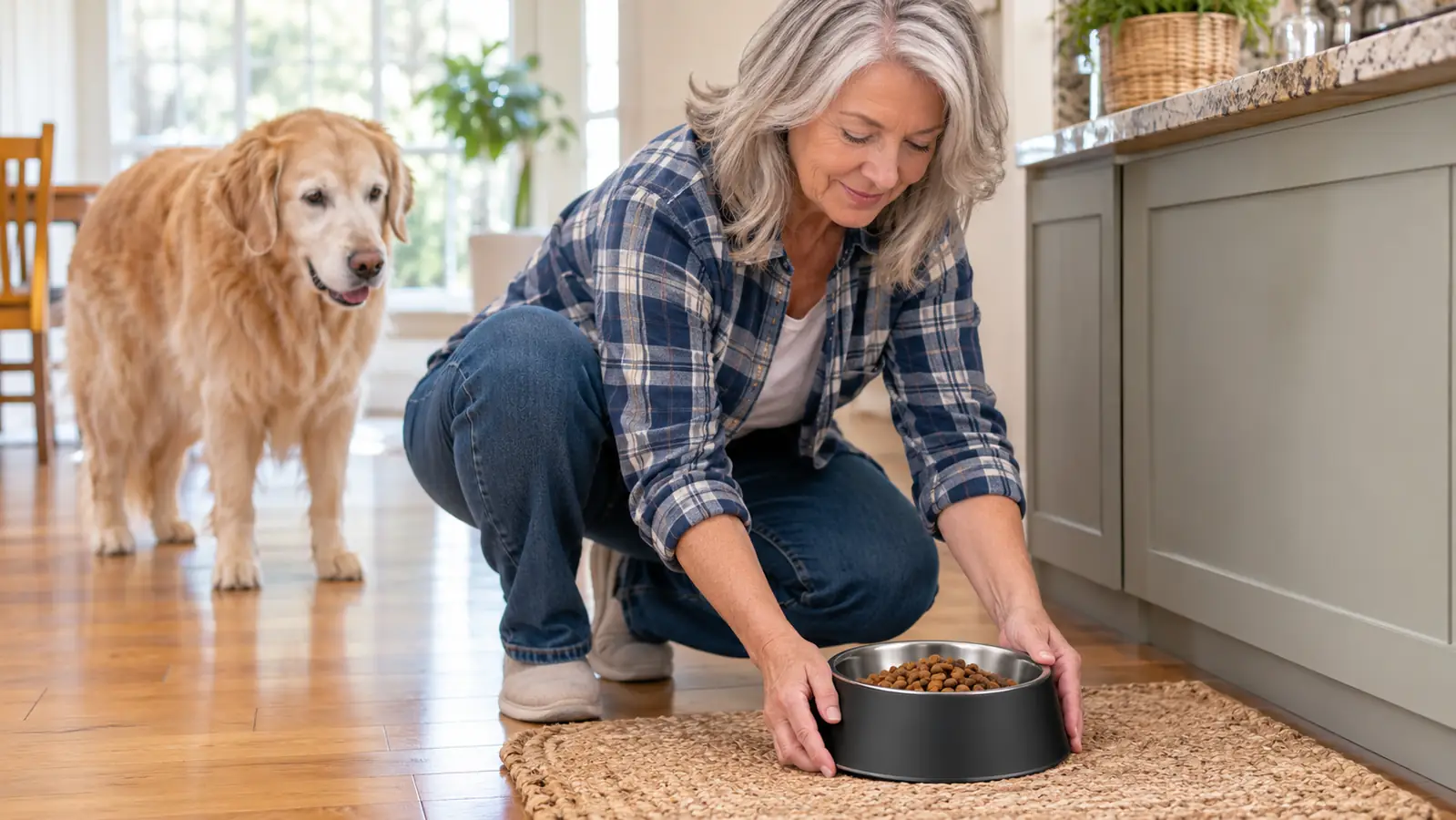
Two meals a day, breakfast around seven and dinner around five, measured with a cup. Juniper is about sixty-four pounds and gets roughly two cups a meal. The bowl holds four cups and measures a little under twelve inches across and about two and a half inches deep, so a two cup meal sits in the ridges with room to spare. It is plastic, it is manual, there is nothing to switch on, and the pattern is the deep maze design that Outward Hound sells as the slowest of their three levels.
I have fed her dry kibble in it almost every day for two and a half years, and wet food on the days her stomach is off and I am being careful with her. The listing says it handles dry or wet food and my experience matches that, though wet food is messier in the grooves, which I will get to. In all that time Juniper has never chewed the bowl. She is not a chewer, so I cannot tell you how it holds up to one. If your dog is a chewer, watch the first few meals, because a determined dog will test the rim.
The part I got right by accident was choosing the slowest level. Outward Hound makes this bowl in Slow, Slower, and Slowest, and I bought the hardest one because Juniper was the fastest eater I have ever fed. If your dog is only a little quick, the slowest maze may frustrate them into walking away. Match the level to the dog, not to the label that sounds most impressive.
Cleaning Is the Part You Will Resent
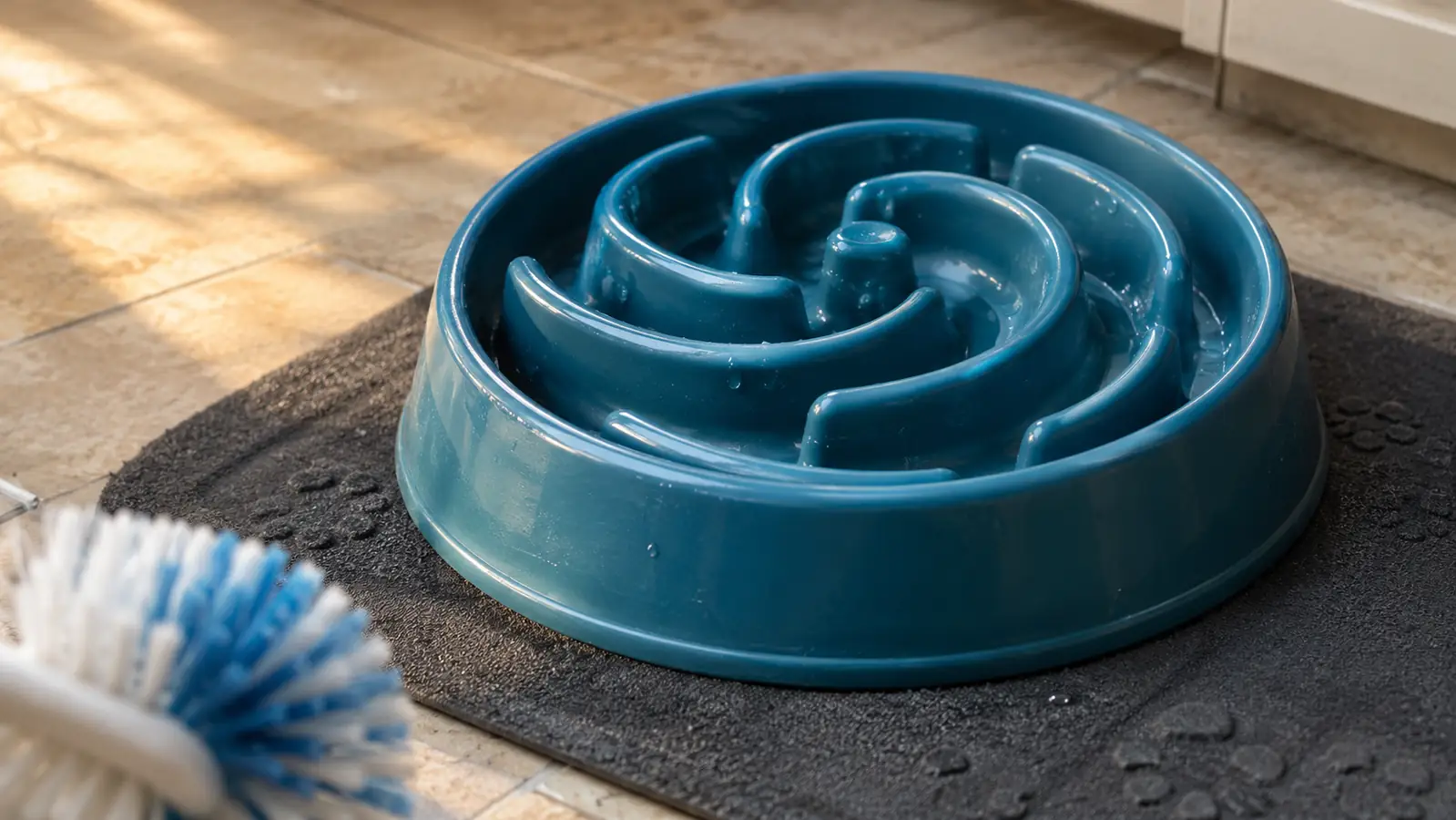
Here is the honest cost of this bowl. It is not the bowl. It is the four to five minutes a week you spend thinking about how much you do not want to wash it, and the sixty seconds a day you spend actually washing it. Kibble dust plus dog saliva sets into those ridges like a thin paste. A quick rinse under the tap does not get it. You will run your thumb along a groove a day later and find grit.
What works for me is boring. I fill the bowl with hot water and a drop of dish soap right after she finishes, while I am still standing at the sink anyway, and let it sit while I do the rest of the kitchen. Then a bottle brush, the kind with a rounded head, works the grooves in one pass each, and I rinse it under running water and set it upside down on the rack. The whole thing is under two minutes if I do not let it dry out first. If I leave it until morning, it takes longer and I am annoyed.
I will also admit to the days I have rinsed it and set it back down. It is plastic, it does not hold a smell the way I expected it to, and on a rushed morning that has been fine. I would not make a habit of it. Once the paste dries in the tight corners it is a small scrubbing job rather than a rinse, and a bowl your dog licks clean twice a day is worth a minute of attention. I hand wash it. I have not put it in the dishwasher, and I would not without the manufacturer saying it is fine, because I am not replacing a bowl over a shortcut.
Sizing, and the Mistake I Nearly Made
I nearly bought the smallest version because it was cheaper and because I was thinking about cupboard space. That would have been a waste. A slow feeder only works if the food has to travel. If you buy one that is too small and then heap the kibble so it sits proud of the ridges, your dog eats off the top like it is a normal bowl and you have bought a plate with texture. The bowl needs to be wider and deeper than the meal.
The reverse mistake is overfilling a big one. Four cups is the capacity, but four cups is not the amount to serve. I feed two cups into a four cup bowl and the kibble settles below the ridge line, so Juniper has to push it uphill to get it. That is the entire mechanism. If you are feeding a small dog, look at the smaller sizes in the same line rather than giving a six pound dog a bowl the size of a dinner plate. There is a size chart on the listing. Use it instead of guessing from the photo, because the photo makes the bowl look smaller than it is.
Dinner went from about forty seconds to roughly six minutes. That is the whole case for this bowl, and in my kitchen it was enough.
The Slip Problem, and What I Did About It
This bowl is light. The listing puts it around fifteen ounces, and there is nothing on the bottom of it that grabs a floor. On the tile by my back door it will skate. Juniper pushes her nose into the far ridge to get at the last of the kibble, the whole bowl slides a few inches, and she follows it. On a rug or on the old wood floor in the hallway it stays put better, but tile is a different story and my kitchen is tile.
The fix cost me nothing because I already had it: a rubber mat that used to sit under a water bowl, or a folded dish towel on the days the mat is in the wash. The bowl lives on the mat now and has not wandered since. If you have hardwood and a dog who really leans into their food, plan on putting something under it. That is not a defect exactly, it is just physics, and it is the sort of thing I would rather know before the bowl arrives than after the first meal.
What I Liked
- Slowed a forty second dinner to several minutes, twice a day, for two and a half years
- Deep maze ridges that a sixty-four pound dog actually has to work at
- No batteries, no moving parts, nothing to break or replace
- Four cup capacity fits a two cup meal with room to spare
- Has held up through daily use with no cracks, warping or worn edges
- Handles both dry kibble and wet food
Where It Falls Short
- It is a daily hand wash, not a rinse, and the grooves hold kibble paste
- It slides on tile and smooth floors unless you put a mat under it
- The slowest level is genuinely frustrating for a dog who only eats a little fast
- Overfill it and the maze stops working entirely
- Wet food is noticeably more work to clean out of the ridges
What It Fixed and What It Did Not
It fixed the speed, and the speed was the thing causing the problem. Juniper used to finish a meal in under a minute and then bring it back up maybe once or twice a month, usually on a day she had been running around before dinner. Since March 2024 I can count on one hand the number of times that has happened. She also settles faster after eating, which I did not expect. I think she is simply tired from the work.
What it did not do is take weight off her, make her calmer during the day, or replace any part of her routine that was already working. The few extra pounds she was carrying came off with measured portions and a longer evening walk after I switched her food in early 2025, over about ten days of mixing old and new because her stomach does not tolerate sudden changes. The bowl was not part of that. And it is not a training tool. Outward Hound lists mental stimulation as a use, and I am sure it is for some dogs, but for Juniper it is dinner, not a hobby.
Who This Is For
This is for the person standing in the kitchen watching a dog finish a meal in the time it takes to fill the water bowl, especially if that dog coughs, hiccups, or brings food back up right afterward. It is for medium and large dogs on measured meals, for people who do not mind washing a bowl by hand every day, and for anyone who wants a feeding tool with nothing electronic in it. It also suits a household where the dog is fed in one spot on a mat, because that is where this bowl is happiest.
Who Should Skip It
Skip it if your dog is a chewer, or if you are not willing to hand wash a ridged bowl most days, because that is the real ongoing cost of owning one. Skip it if you free feed, since a slow feeder only makes sense for a measured meal. Skip it if your dog is dropping weight or vomiting often, and see your vet instead. And skip the slowest level if your dog is only a mildly fast eater, because there is a version of this bowl one step easier and it will suit them better than the maze that Outward Hound builds for the dogs who inhale.
Two and a half years in, I would buy this bowl again tomorrow
Same pattern, same size, same mat underneath it. If you have a fast eater and a tile floor, start with the level that matches your dog rather than the hardest one, and read the size chart before you choose.
Amazon Check Today's Price on Amazon →If we were sitting at my kitchen table, this is what I would tell you. Buy the bowl, buy the size that fits the meal rather than the cupboard, put a mat under it, and wash it while you are still standing at the sink. Do not expect it to fix a dog's weight or a dog's stomach, and do not skip your vet because a bowl seemed to help. But if the sound of a meal being inhaled in forty seconds has worn you down, this thing does what it says, and it is still doing it in my kitchen two and a half years later.