Juniper used to finish dinner in under a minute. Not exaggerating for effect. I timed it once with the kitchen clock and got forty-some seconds, and that was with me standing right there telling her to slow down in a voice she ignored completely. Then she would look up, burp, and about twice a week bring the whole thing back up on the rug by the door.
She is a 10-year-old Golden Retriever, about 64 pounds, white around the muzzle. I have fed and cared for other people's dogs around Bozeman, Montana for about twelve years, and before that I managed a school cafeteria, which is where I learned to read every label on everything. So when a dog eats like a shop vac, I notice. In March 2024 I bought the Outward Hound Fun Feeder in the Drop pattern, the wide shallow one that holds about four cups. We have used it for both meals every day since. That is about two and a half years of twice-daily use, and I have a fairly settled opinion of it by now.
The Quick Verdict
It did the one job I bought it for: dinner went from forty seconds to several minutes, and the bringing-it-back-up mostly stopped. Two and a half years in, the plastic has held up and Juniper has never chewed it. It is not a fix for a medical problem, and it is a nuisance to wash.
Amazon Check Today's Price →If your dog eats like the bowl is being taken away from them, this is the cheap fix I'd try first
Juniper has eaten out of the Outward Hound Fun Feeder twice a day since March 2024. Still the same bowl. Still slower than she used to be at an empty bowl.
Amazon Check Today's Price on Amazon →How I've Used It
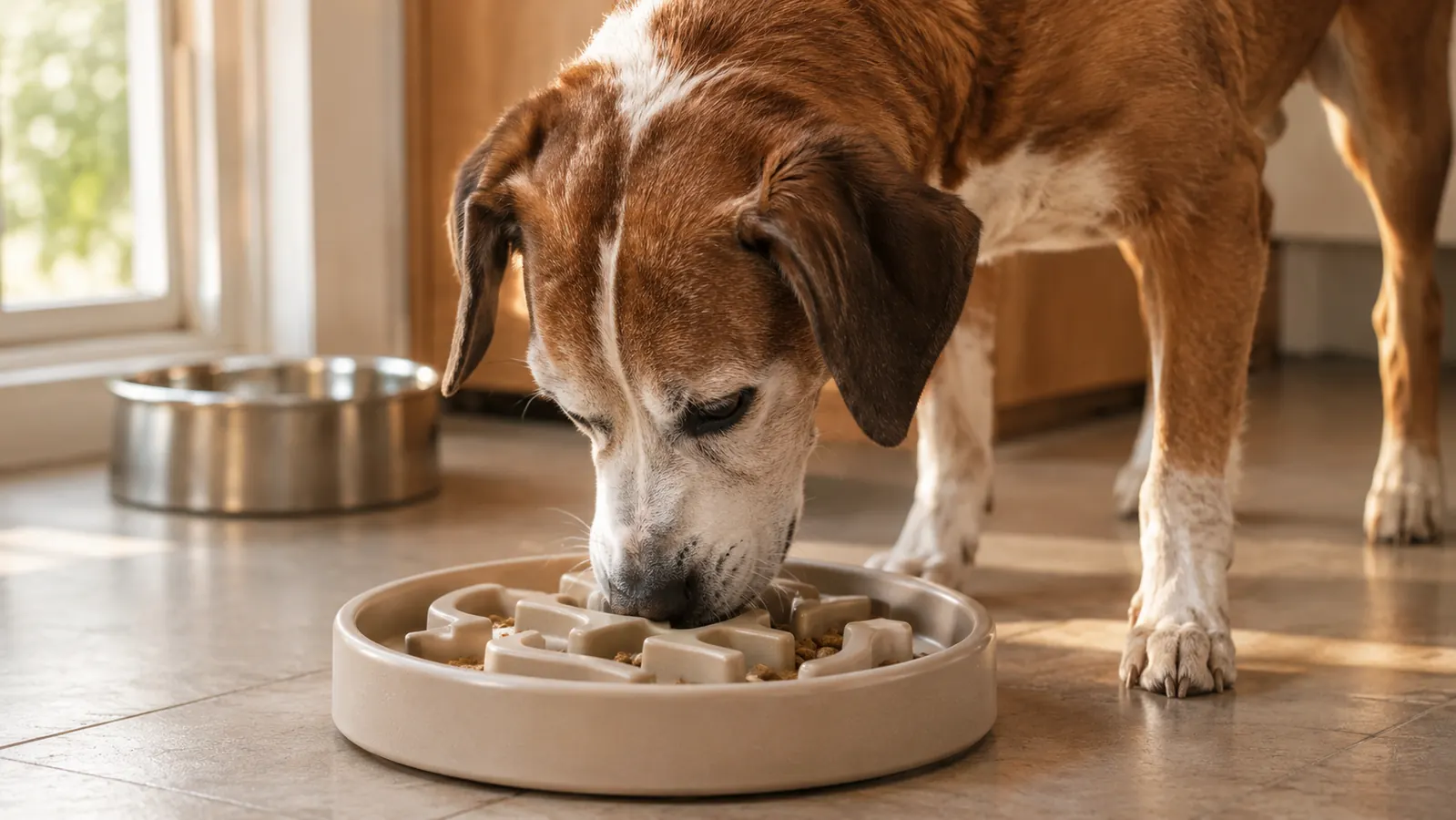
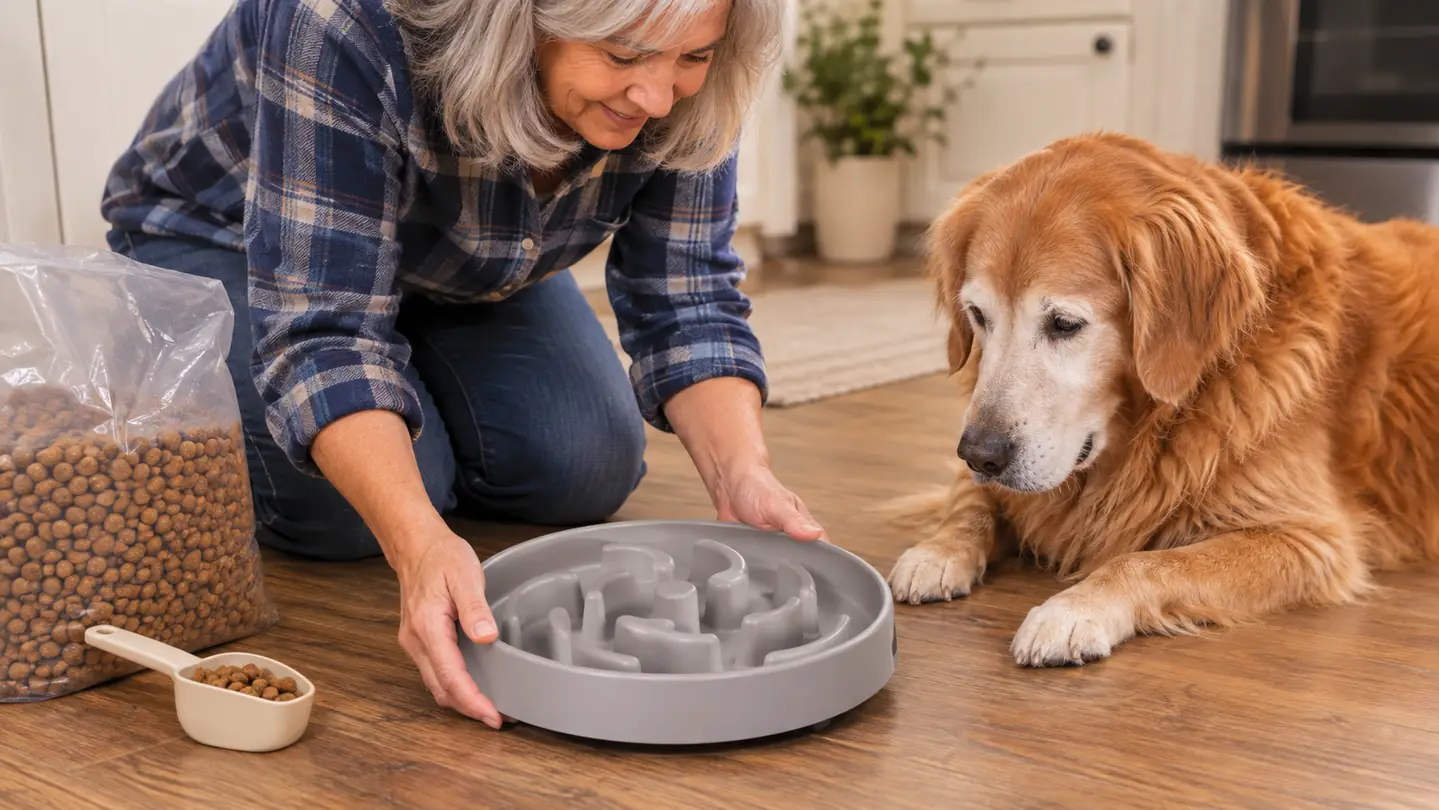
I want to be clear about what this bowl is, because I think a lot of people buy it expecting the wrong thing. It is a plastic bowl, about 11.8 inches across and roughly two and a half inches deep, with ridges molded into the bottom that turn a pile of kibble into something closer to a maze. The food does not sit in a heap. It settles into the channels, and the dog has to work it out with her tongue and her muzzle instead of scooping it up in three gulps.
I put it down at breakfast around seven and at dinner around five. Same routine, every day, for two and a half years. I feed measured portions, and the bowl holds about four cups, which is more than Juniper gets in a meal, so capacity has never been a concern for us. It weighs about fifteen ounces empty. On our kitchen floor it does not slide around much, though on a smooth floor with a determined dog it might.
My first attempt, long before I bought anything, was a muffin tin. I had read about it somewhere, filled the cups with kibble, and set it down. Juniper nosed it once, flipped the whole tin over with one paw, ate the kibble off the floor in roughly the same forty seconds, and then carried the tin into the living room. I also tried spreading the food across a cookie sheet, which worked for about a week until she figured out she could push it across the floor with her nose and let the kibble pile up against the baseboard where she could lap it. What the Fun Feeder has that neither of those had is a rim and a set of channels. The food cannot be pushed out of it and it cannot be tipped out of it.
Washing is the part nobody mentions. I hand wash it in the sink most days. The channels are the whole point and they are also where wet kibble residue collects, so a quick rinse is not enough. A bottle brush or a sponge with a scrubby side gets into the grooves in maybe thirty seconds. If you are the kind of person who will not do that, be honest with yourself about it, because a slow feeder that is not cleaned is worse than a regular bowl.
What Changed at Dinnertime
The first week was funny to watch. Juniper circled the bowl, tried to take her usual scoop, and got almost nothing. She looked at me like I had played a trick on her. Then she settled in and started working at it with her tongue, and it took her several minutes to clear it.
That has held up. Two and a half years later she is faster at it than she was in March 2024, because she has learned the pattern, but she is still working at it for minutes rather than seconds. The gap between finishing and looking up at me is where the whole benefit lives. She is not inhaling air with her food, and the scarf-and-barf routine that used to happen a couple of times a week has mostly stopped.
I will not tell you it never happens. It happened twice this past year, both times when I fed her a little later than usual after a long walk and she was frantic. But going from roughly twice a week to roughly twice a year is the difference between a habit and an occasional annoyance, and I will take it.
Let me give you one specific evening, because I think it says more than a general claim. It was a cold night last January, icy enough that our evening walk got cut short, and I fed her at five as usual. I stayed in the kitchen to watch instead of wandering off. She started at the outer ring, worked her way around, and got stuck for a good while on a pocket of kibble near the center where the ridges funnel everything together. She backed up, licked her own nose, and came at it from a different angle. Six minutes, give or take. In March 2024 that same meal would have been gone before I got the scoop back into the bin.
One thing I did not expect: she seems calmer after meals. I am careful not to overstate that. A dog who eats in forty seconds and then stands there vibrating is not the same dog as one who spent six minutes working for her food. Whether that is the bowl or just her being ten years old, I cannot say for certain. I noticed it, and I will leave it at that.
The gap between finishing and looking up at me is where the whole benefit lives.
The Plastic, the Pattern, and Two and a Half Years of Wear
This is where I expected trouble and did not get it. Juniper is not a chewer of bowls. She has never once put her teeth on it, and I know that because I have looked, and there are no tooth marks on the rim after two and a half years. If you have a dog who chews plastic, this is not a chew toy and it will not survive being treated like one.
The plastic itself has held up well. No cracks. No splitting at the ridges. The finish has faded slightly over the two and a half years, mostly from hot water and dish soap, and there are some faint scratch marks in the channels from washing. That is cosmetic. It still holds food and it still does the job.
I check it about once a month, usually on a Sunday when I am already doing the rest of the kitchen. I hold it up to the window and look down each ridge for hairline cracks. Two and a half years in, I have not found one. I also run my thumb along the inside of the rim, where a dog's lower jaw would catch it if she were the type to grab, and it is still smooth there. What I do find is a dulling of the surface inside the channels, the way a plastic cutting board goes dull where the knife keeps hitting it. That is from scrubbing, not from Juniper. I have thrown out plenty of things in this house that looked fine and were not. The Outward Hound bowl is not one of them.
The Drop pattern is, as far as I can tell from the listing, one of the more difficult mazes in the line. The manufacturer describes it as their slowest level, meant for very fast eaters. That matches what I saw. If your dog is a moderate eater and does not gulp, you may find this pattern frustrating for them in a way that is not useful. A dog who gives up on a bowl and walks away is not being helped.
Where It Fits in Juniper's Actual Routine
I want to place this bowl in the larger picture, because a bowl is not a nutrition plan and I would be doing you a disservice to suggest otherwise. Juniper eats Blue Buffalo Life Protection Senior 7+ now, chicken and brown rice, measured with a cup twice a day. We switched to it in February 2025 over about ten days, mixing old and new, because her stomach does not tolerate sudden changes. She also gets a joint supplement at breakfast and a pump of fish oil over her kibble, both per the label and with her vet in the loop.
None of that is the bowl's doing. What the bowl does is make her take her time with what is in front of her. That matters more as a dog gets older, not less. A ten-year-old Golden with a sensitive stomach is not a dog I want eating at speed. Slowing down the meal is one small, cheap, low-risk thing I can control, and I would rather control it than not.
Here is the part that matters most to me now that she is ten. In the winter our morning walk is shorter and slower, and she comes back stiff. I do not want a stiff dog bolting a bowl of kibble. On the cold mornings I put the bowl down and I leave the room, because standing over her makes her eat faster. She works at it, she finishes, and she goes and lies on the rug by the woodstove. At her yearly checkup this fall the vet asked about her appetite and her weight, I said both were steady, and that was the end of it. Nobody at that clinic has ever told me a bowl would add years to her life. What they have told me, more than once, is to keep her lean and keep her moving.
I also want to be honest about the limits. A slow feeder does not stop a dog from gaining weight if the portions are too big. It does not treat a stomach problem. It did not fix Juniper's stiff mornings, and I never expected it to. If your dog is bringing food back up regularly, that is a conversation with your vet, not a shopping decision. I say that as someone who has cleaned up plenty of it.
What I'd Tell a Friend Who Asked
I have recommended this bowl to two people. One had a Lab who ate so fast he would go straight to the water bowl and then bring everything back up. The other had a smaller dog who was gulping and then coughing. Both of them came back and said some version of well, that worked. Neither of them said it was a nice bowl to wash.
That is the honest summary. It is not a beautiful object. It is a wide plastic bowl with a maze in the bottom, and it costs less than most things I have bought for this dog. The Outward Hound bowl has done exactly what it claimed for two and a half years of hard daily use, and it has never given me a reason to go looking for something else.
What I Liked
- Turned a forty-second meal into several minutes, consistently, for two and a half years
- The scarf-and-barf pattern dropped from roughly twice a week to roughly twice a year
- Held up to twice-daily use and hand washing with no cracks or splits
- Holds about four cups, which is more than a large dog needs in one meal
- Wide base stays put on the kitchen floor
Where It Falls Short
- A nuisance to hand wash, and the channels need a brush or a scrubby sponge
- The slowest-level maze can frustrate a moderate eater to the point of giving up
- Not chew-proof. A dog who chews plastic will destroy it
- The pattern gets easier for the dog over time, so it slows less than it did in month one
Who This Is For
This is for the person standing in the kitchen watching their dog inhale a bowl of kibble in under a minute and then worried about what happens next. It is for dogs who gulp and then gulp water and then bring it back up. It is for anyone who has already tried a bigger bowl, a smaller bowl, or spreading the food out on a plate and found none of it made a real difference.
It is also, honestly, for the person who wants a cheap thing to try before spending money on anything more elaborate. That is why I bought it. It is one bowl. It sits on the floor. It either helps or it does not, and you will know within a week.
Who Should Skip It
Skip it if your dog chews plastic bowls, because this one will not survive that. Skip it if your dog is a moderate or slow eater already, because the Drop pattern is one of the more difficult mazes in the line and there is no benefit to frustrating a dog who was never fast to begin with.
Skip it if you know you will not wash it properly. Those channels collect residue and a bowl that is not cleaned is a problem you did not have before. And skip it if you are looking for something that solves a medical issue. It does not. It slows a meal down. That is the whole of it, and it turns out that was worth a great deal in this house.
Two and a half years, one bowl, and a dog who finally chews her food
Juniper has eaten from the Outward Hound Fun Feeder twice a day since March 2024. Same bowl, same kitchen floor, still slower at dinner than she used to be. If your dog eats like the bowl is about to be taken away, start here.
Amazon Check Today's Price on Amazon →