

Juniper turned ten this fall. The white muzzle showed up around age eight and never left, and on a cold morning she needs a beat longer to get up off the rug than she did at six. I put her on Blue Buffalo Life Protection Senior 7+ in February 2025, which makes it about a year and nine months of two meals a day out of the same bag, and by now I trust my opinion of it more than the one I had at week three.
This is not a lab report and it is not veterinary advice. I am a pet sitter, not a vet. I have spent about twelve years going in and out of other people's houses around Bozeman, Montana, feeding other people's dogs and learning how many of them live, and before that I managed a school cafeteria, which is where I learned to read the panel on the back of a bag instead of the picture on the front. What follows is one dog, one bowl, and an honest account of the last year and nine months. Anything medical, ask your own vet.
What I am not going to do is tell you that a bag of kibble adds years to a dog's life. It does not. What I can tell you is what changed in this house, what did not change no matter how much I wanted it to, and what I would say to somebody standing in an aisle with a ten-year-old dog and a bag in each hand.
The Quick Verdict
Steady weight, predictable digestion, and a clean bowl twice a day for about a year and nine months. The trade is a 15 lb bag roughly every three weeks and a dog who now refuses the food she used to eat.
Amazon Check Today's Price →The bag Juniper has eaten twice a day since February 2025
Blue Buffalo Life Protection Senior 7+ in chicken and brown rice, 15 lb. Real chicken first, corn, soy, and wheat free, and about a year and nine months of empty bowls in this house.
Amazon Check Today's Price on Amazon →How I've Used It
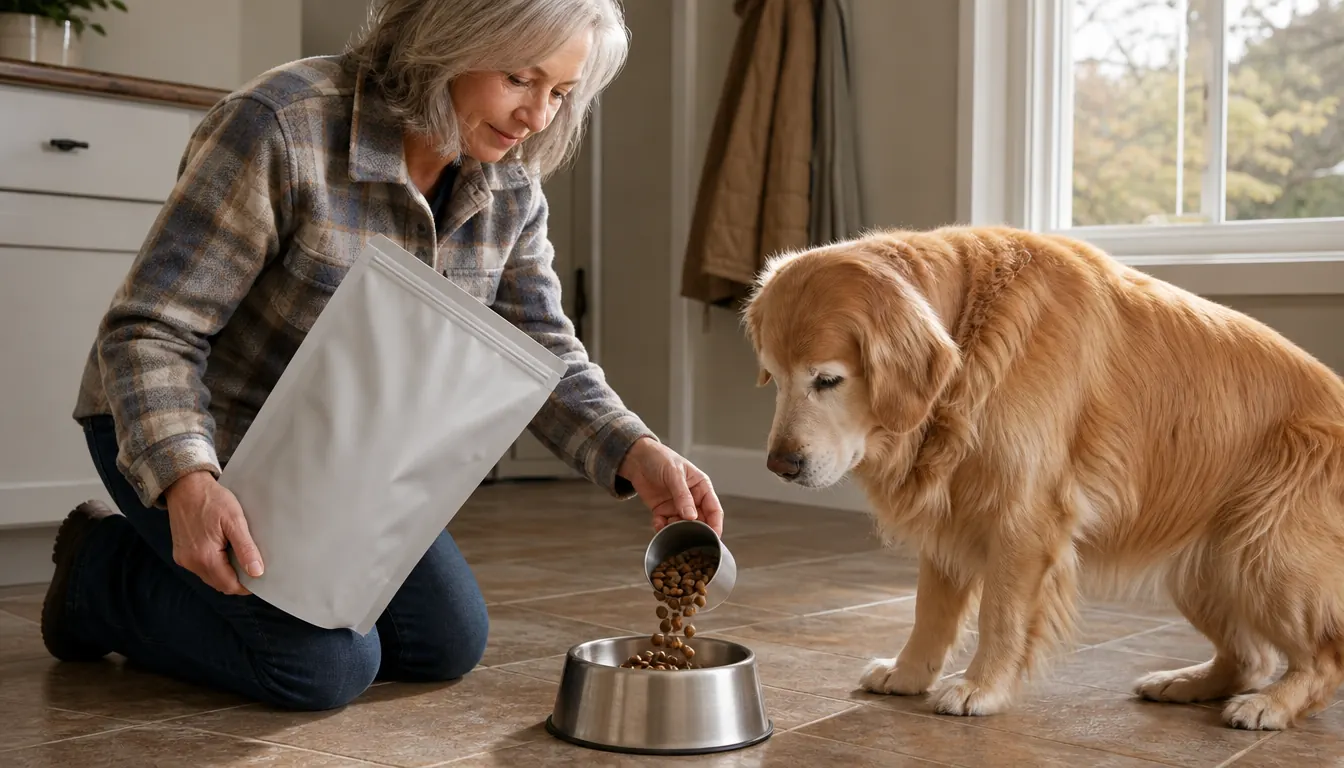
Two meals a day, breakfast around seven and dinner around five, measured with a cup and never eyeballed. The amount is whatever the bag says for her weight and whatever our vet has adjusted at her yearly checkup, and it gets written on the whiteboard by the back door so nobody in this house has to guess. Juniper is about 64 pounds. She is ten. She has a white muzzle and a very strong opinion about the five o'clock meal.
Here is what eyeballing used to cost me. For about a year before this, I would fill the cup, shake it level with my thumb, and then add what my mother would have called a generous pour, because Juniper looked hungry and I am a soft touch. That is maybe an extra quarter cup a day, twice a day, and it is the kind of arithmetic that never shows up on any single morning. It shows up on a collar. Now the cup gets leveled flat against the rim of the container and that is the end of the discussion.
The changeover in February 2025 took about ten days, mixing the old food with the new and shifting the ratio a little each day. Juniper has a sensitive stomach and a sudden change in food has never gone well for her, so I was in no hurry. Ten days was slow enough that nothing happened at all. No loose days, no trip outside at three in the morning, no rug to clean. That is the entire goal of a slow switch and I would do it again exactly the same way.
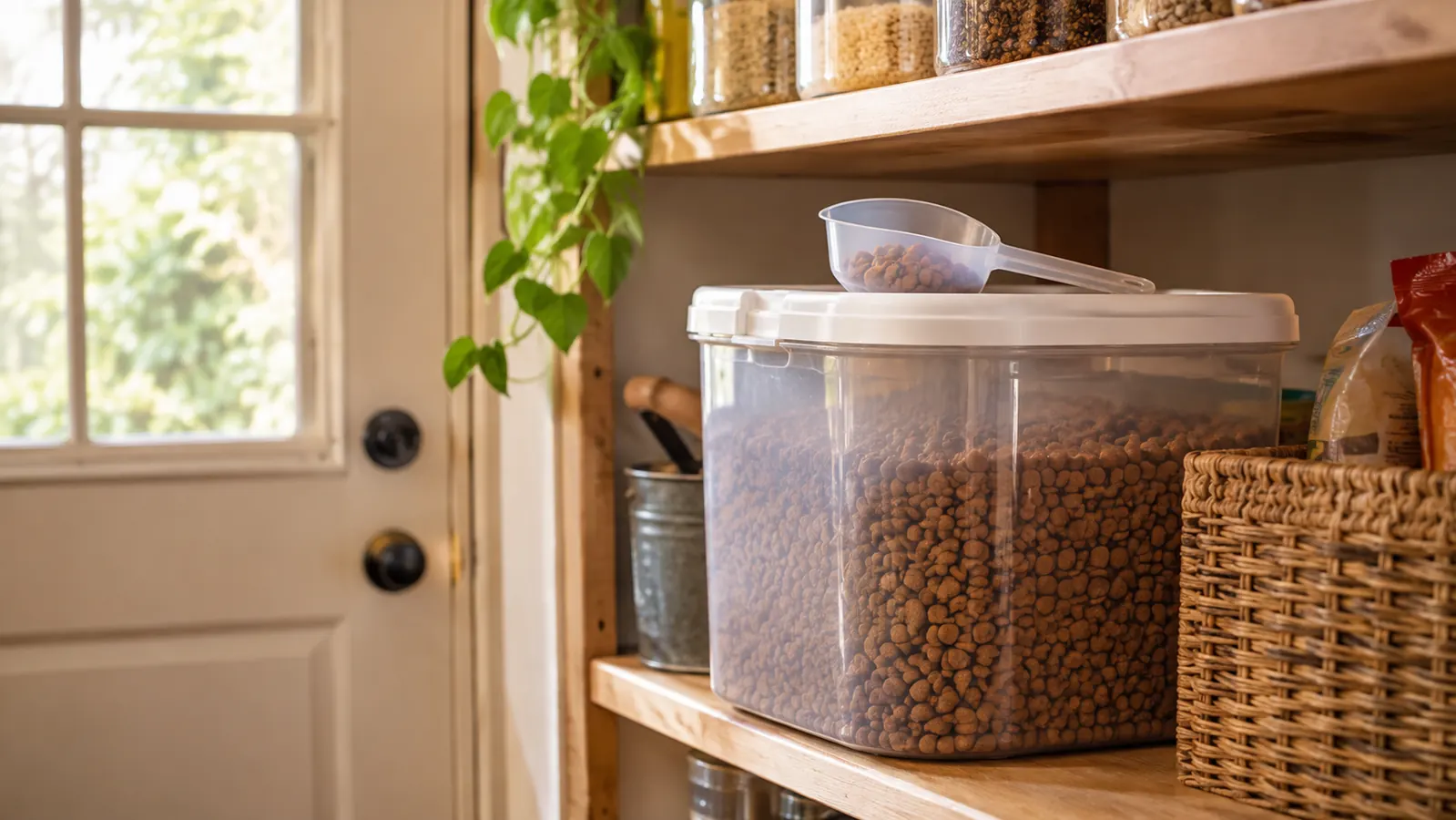
The bag lives in a storage container in the pantry by the back door, on wheels, because a few winters back mice got into a bag in the garage and I am not doing that again. The 15 lb bag empties in with room to spare, the lid seals down, and there is a plastic scoop that lives inside. I hand wash the container between bags and let it dry upside down on the porch. That is the whole system, and it has not changed in about a year and nine months.
One thing I have noticed about my own habits: I measure more carefully with this food than I ever did with the adult formula. Part of that is having a ten-year-old dog on my hands. Part of it is that the bag gives you a real amount for a real weight and it is easy to follow. When portions get eyeballed, a dog drifts upward slowly and nobody notices until the collar is tight. That drift is exactly what we were correcting.
What's Actually in the Bag
Real chicken is the first ingredient. That is printed on the bag, and it is the main reason I picked it up the first time. I have fed enough dogs to know that the first few ingredients tell you more than the front of the package does, and a senior formula that leads with a named meat is starting in the right place as far as I am concerned.
It is corn free, soy free, and wheat free, and it does have grain in it. I want to be clear about that, because people hear the first half and assume the second. Grain is not the problem in my house. Juniper does fine with it, the fiber does her good, and I would rather see brown rice on a panel than a long list of things I cannot pronounce.
I read the panel in the aisle the way I used to read a cafeteria order form, which is to say slowly and with suspicion. What I wanted to know was whether the grain was still in there and whether the protein was named. Both answers were yes. Then I turned the bag over and looked at the kibble itself. It is a pellet, and the pieces are small enough that a dog does not have to work at them. Juniper is ten and she has the teeth of a ten-year-old dog, and I have watched her walk away from food that was too big to pick up comfortably. That is not a small detail at this age, and it is the kind of thing you only learn by putting the bowl down and standing there watching.
The LifeSource Bits are mixed through the kibble rather than sitting in a separate pouch. Those are the pieces Blue Buffalo adds for antioxidants, vitamins, and minerals. Juniper does not pick them out, which I mention because I have sat for dogs who pick them out and leave them in a neat pile beside the bowl. If your dog is a picker, you will know by the end of week one.
The kibble comes in a 15 lb bag, which is the size that makes sense for a 64 pound dog eating twice a day. It is not a large breed formula and the bag lists all breed sizes. For a Golden that is fine. For somebody with a much bigger dog, the portions and the bag size may not line up as neatly, and I would do that arithmetic before committing to a subscription.
What Changed Over About a Year and Nine Months
The extra weight came off first. Juniper was carrying a few pounds around the middle at nine, and with measured portions and a longer morning walk she lost them over the first few months. She moves better for it. That is not a credit to a bag of food, it is what happens when an older dog carries less weight on older joints, and I am not going to dress it up as anything else.
Her digestion settled. I had gotten used to one loose day a month being normal, the way you get used to a lot of things, and it stopped being normal. Her stools are consistent now and her coat looks better than it did a year ago. The coat is partly the omega-3 oil I pump over breakfast, so I am not handing the food all the credit there either.
I keep a note on my phone, which sounds more organized than it is. Mostly it is one line every few weeks: weight at the vet, how the morning walk went, whether she finished both meals. The January entry says she stood at the top of the porch steps for a good five seconds before she took them, and that was ice, not food. The entry from the following week says she took them without hesitating. If you are going to judge a food, you need a few months of those lines, because one bad morning will talk you into changing everything and one good one will talk you right back out of it.
Energy is the one I am careful about. She is ten. She naps more than she did at six, and she is slower on the icy mornings in January, when the porch steps are slick and she thinks about it before she commits a paw. Feeding her a senior formula did not turn her back into a two-year-old and I would not trust a review that claimed otherwise. What I can tell you is that she is eager for both meals, she finishes them, and she still wants the evening walk even when it is cold enough that I do not.
Appetite has been the most consistent thing about her. In about a year and nine months there has not been a single bowl left sitting. That sounds like a small thing until you have had a dog who goes off her food, and then it is the only thing you think about all day long.
How It Compares to What We Fed Before
Before this, we were on an adult chicken formula and it was fine right up until it was not. The food did not change. Juniper did. A ten-year-old dog with a sensitive stomach and a few extra pounds does not need the same bowl as a six-year-old dog who patrols the fence line all afternoon and comes in ready for round two.
I compared the senior version of her old food against Blue Buffalo Senior 7+ in the aisle, panels side by side, and picked this one because of the first ingredients and because it is corn, soy, and wheat free without dropping grain entirely. That last part matters to me. I am not interested in a formula that takes out something a dog can use just so the front of the bag can say something that sounds cleaner than it is.
If you are weighing two senior foods against each other, the honest answer is that both will feed a dog. The difference is what is in them, how your dog handles them, and whether the portions on the bag line up with what your vet has told you about your dog's weight. The rest is marketing and the back of the bag, in that order.
What I Liked
- Real chicken is the first ingredient and it is printed where you can check it
- Corn free, soy free, and wheat free, with grain still in the formula
- Juniper has eaten it twice a day for about a year and nine months without one refusal
- Measured portions plus more walking took off the extra weight she was carrying
- The LifeSource Bits are mixed through the kibble, so there is nothing to pick around
Where It Falls Short
- A 15 lb bag lasts us roughly three weeks, which is a lot of bags in a year
- The switch has to be slow. Ten days of mixing, or a sensitive stomach will tell you about it
- It is a senior formula. It is not the right bowl for a young, hard running dog
- No food fixes a stiff joint. If you expect the bag to do what your vet does, you will be disappointed
- Juniper now refuses the adult food she used to eat, so there is no casual switching back
Less weight on an older dog's joints is less weight on an older dog's joints, and no bag of food does that part for you.
Who This Is For
This is for the person with a dog somewhere past seven who has started to slow down, who has put on a few pounds around the middle, and whose stomach does not handle a sudden change in food. If you already read panels and compare first ingredients before you put a bag in the cart, you are the reader I had in mind when I wrote this down.
It is also for the person who wants one food, twice a day, measured, with no toppers and no rotating brands. Juniper gets this with a pump of omega-3 oil over the top at breakfast and that is the entire program. Simple suits us. I have friends who cook for their dogs and I respect it enormously and I am not doing it.
And it is for the person who is willing to change the portion before they change the food again. Half the senior dogs I have sat for were not on the wrong food. They were on the right food in the wrong amount. Measure it, write it down, give it a few months, and then decide what the bag is or is not doing for your dog.
Who Should Skip It
If your dog is under seven and healthy, this is not the bag for you. A senior formula is not a head start, it is a match for a dog who has already slowed down. Ask your vet what actually fits a younger dog instead of buying age on the front of a package.
If your dog has a diagnosed condition and is on a prescription diet, do not swap it out because a stranger on the internet feeds this to her Golden. That is a conversation with your vet and it is not one I get a vote in. The same goes if your dog has a known allergy to chicken, which rules this formula out entirely.
And if you want a food that fixes a stiff joint, skip it and read the label on a joint supplement instead, then call your vet about whether that is even the right step. I have been down that road with Juniper and the food was never the thing doing the heavy lifting.
If your senior has slowed down and the old food stopped fitting
Blue Buffalo Life Protection Senior 7+ in chicken and brown rice, 15 lb. About a year and nine months of clean bowls, steady weight, and no refusal in this house.
Amazon Check Today's Price on Amazon →