
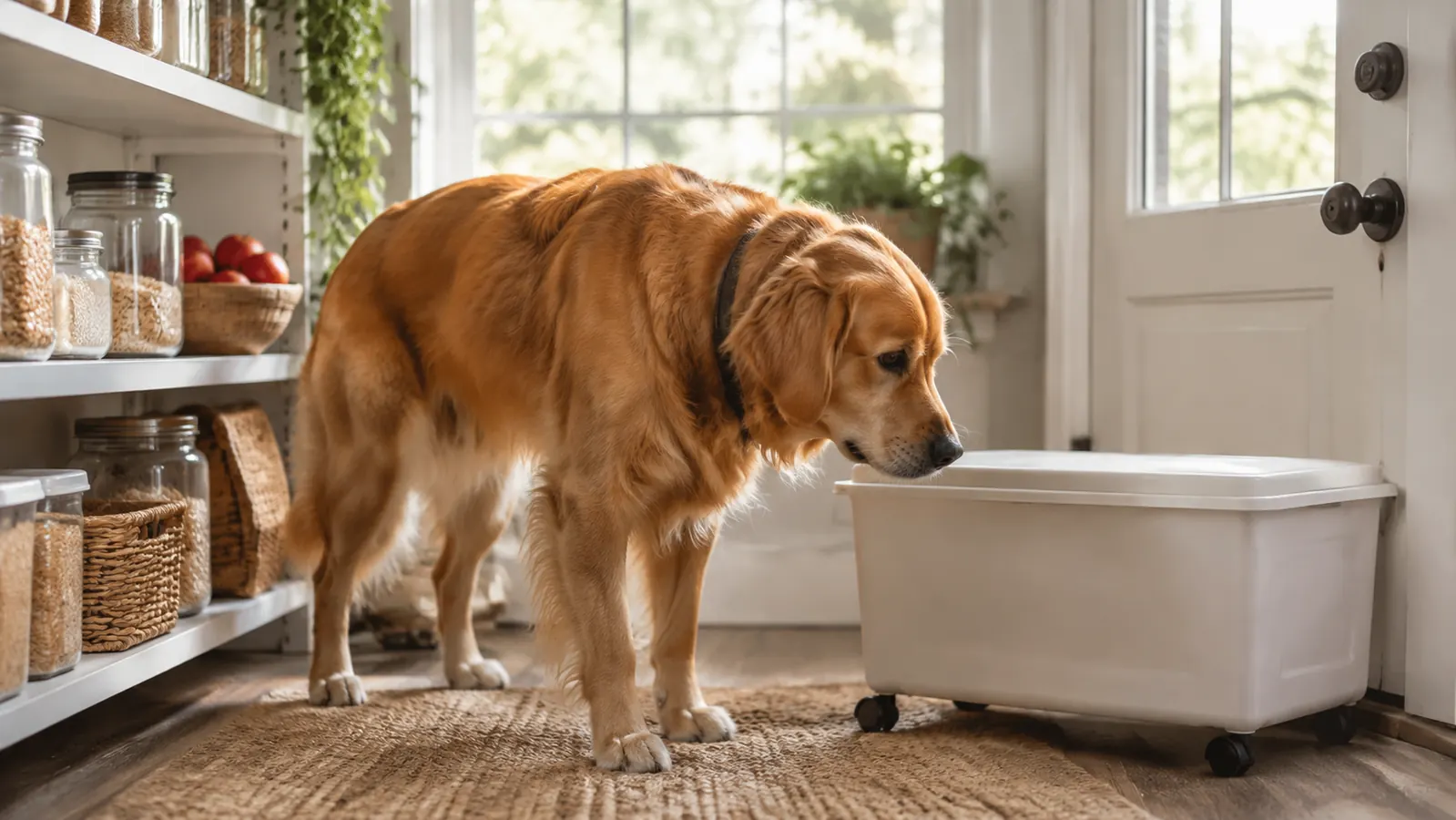
The mice got into the kibble first. That is the honest beginning of this. I had a bag of dog food sitting open on a shelf in the garage one winter, and by the time I noticed, there was a chewed corner and a mess I would rather not describe. I drove into town the next week and came home with the IRIS USA Food Storage Container, the 54 lb one on wheels, and I have not bought a different bin since.
It has been almost four years now. Same container. Same lid, same scratched side. It lives in the pantry by the back door and it holds Juniper's whole bag, and I have filled it and emptied it and hand-washed it more times than I can count. This is not a review that ends with a drumroll. It is a review from someone who has lived with the thing long enough to be a little annoyed by parts of it and still keeps using it.
The Quick Verdict
A plain, tough bin that seals well and rolls when you need it to. The footprint is bigger than you think and the latch takes two hands. Neither is a dealbreaker.
Amazon Check Today's Price →The bin that ended the garage kibble problem
If you are storing a 30 to 50 lb bag and you are tired of folding the top over and hoping, this is the shape of bin that solves it. Check the current price and the size options before you commit to a corner of your pantry.
Amazon Check Today's Price on Amazon →How I've Used It, and What That Actually Tests
I want to be clear about the limits of what I can tell you. I have one dog. I have used one bin. I am not a vet and I am not an engineer, and I have not run lab tests on moisture levels. What I can tell you is what nearly four years of twice-a-day scooping does to a piece of plastic, and where the design holds up and where it does not.
My routine is boring and that is the point. Juniper eats at seven and again at five. I keep a plastic scoop inside the bin, I fill it from a 15 lb bag about every three weeks, and between bags I take the bin out to the driveway, dump the crumbs, and wash it by hand. The specs say hand wash only and they mean it. I would not put this in a dishwasher and I would not leave it sitting full of soapy water.
I will give you one actual morning, because a routine described in general terms is not worth much. Back in February, the week the cold really set in, I came down at a quarter to seven, popped the near latch, and found the kibble level sitting just below the point where the scoop tips over. So I carried the bag in, poured it out, and the bag went in about two thirds of the way and stopped. That is the moment the translucent side earns its keep. I could see the line of it from the doorway and knew exactly what I was dealing with before I touched anything.
What that routine has tested, over and over: the latch, the seal, the wheels, the lid hinge area, and whether the plastic gets brittle or cloudy over time. It has not. The body is still clear enough that I can see the food level from across the kitchen without lifting the lid, which sounds like a small thing until you have had to open a bin every night to check whether you need to shop.
The Latch Is the Whole Point, and It Takes Two Hands
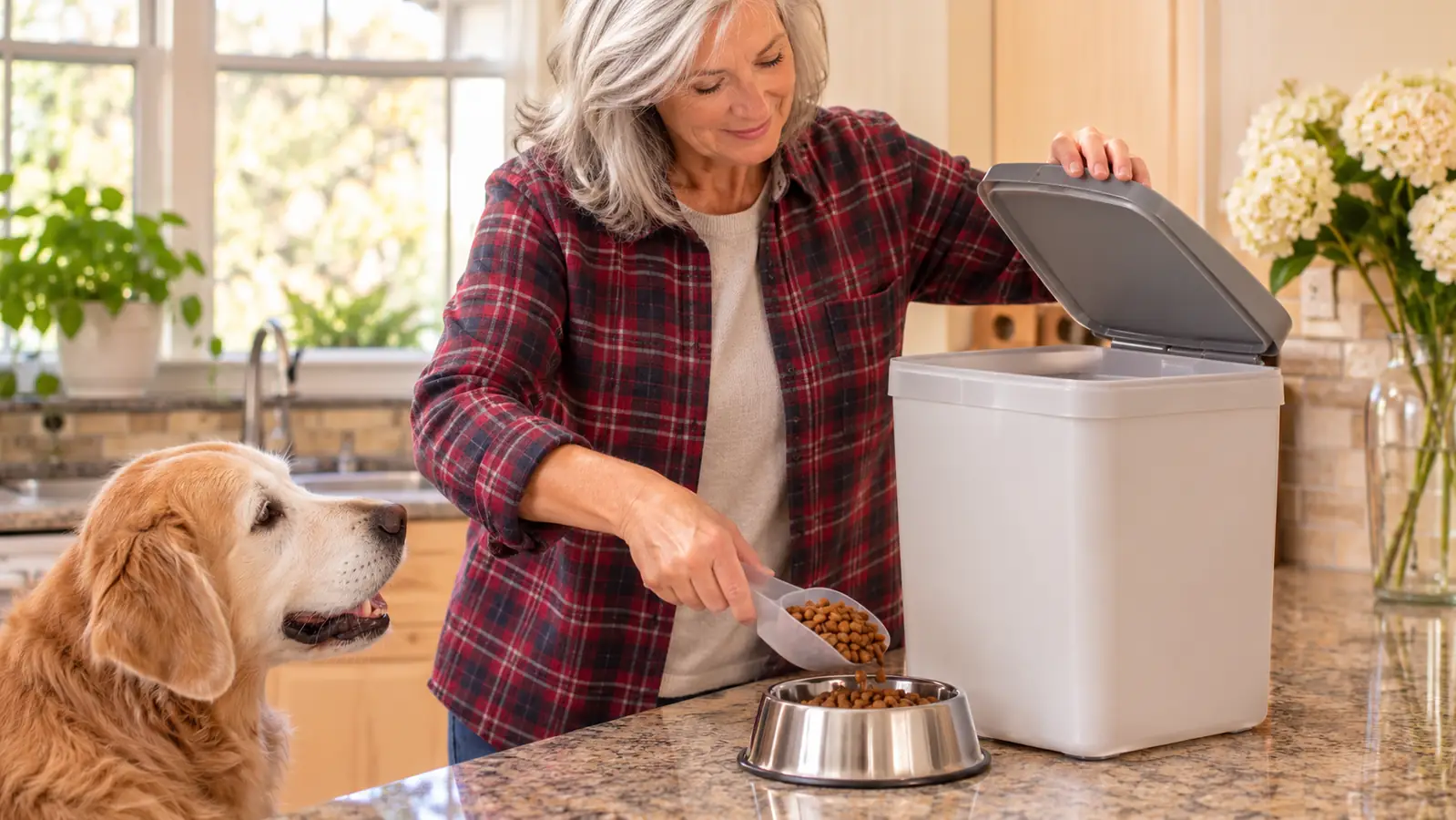
The lid uses snap-lock latches on the sides and they are not decorative. When they are down, the lid is pulled tight against the rim and the bin is closed. When I first got it I thought the latch was overkill for a dog food bin. Then I remembered the garage and the chewed corner and decided I liked overkill.
Here is what nobody tells you about a latch like this: it is a two-hand operation if the bin is full. You hold the bin steady with one hand and pop the latch with the other. On an empty or half-full bin you can do it one-handed from the top and it is fine. Full and on wheels, it will scoot if you are careless, and I have had it roll a few inches toward me while I was fighting with the lid.
My first attempt at a fix was a folded towel wedged under the two front casters. That lasted about a week. It worked, in the sense that the bin stopped moving, but the towel got dusty and then damp from the floor, and I was forever bending down to straighten it. What I do now instead is put my left foot against the front wheel while my right hand works the latch. It is a smaller fix and it costs nothing, and once you have done it ten times it is just how you open the IRIS USA bin. Juniper has learned the sound of it and shows up before the lid is fully off.
That is the trade. A latch that seals tightly is a latch with some resistance in it. If you have hand strength issues or arthritis, or if you are the kind of person who scoops one-handed while holding a leash in the other, this will ask more of you than a bin with a simple flip lid. I would rather have the seal. But I am not going to pretend the latch is effortless, because it is not, and I would have liked to know that before I brought it home.
A latch that seals tightly is a latch with some resistance in it. I would rather have the seal. I just would have liked to know about the resistance first.
The Size Question: 54 lbs Is a Commitment, Not a Convenience
Fifty-four pounds of dry food is a lot of dog food. The bin measures roughly 18 inches long by 15 wide by 23 and a half tall with the casters on, and 21 and seven-eighths tall without them. It weighs about 4.8 lb empty, which sounds light until you have filled it and remember you have to move it.
I bought the big one because I wanted to pour a whole bag in without playing Tetris with the leftovers. That part works exactly as advertised. A 15 lb bag empties into it and barely makes a dent, and I can see the level through the side. If you buy in bulk or you have more than one dog, the capacity is the reason to pick this size.
But 54 lbs of capacity is a footprint, and the footprint is what I did not think through. It takes up a real corner. In my pantry it works because the corner by the back door was dead space anyway. In a small kitchen with no pantry, this thing is furniture whether you want it to be or not. If you are storing a 15 or 20 lb bag and nothing else, the smaller sizes in the IRIS USA line do the same job without eating your floor.
Before I committed to that corner I did the thing I should have done first: I cut a piece of cardboard to the footprint on the spec sheet, 18 by 15, and set it on the floor for a day. It promptly got walked into twice. I moved it an inch and a half toward the wall, laid a tape measure against the door frame, and found I had room with about three inches to spare. That three inches is exactly what lets the bin roll out and back without catching the door.
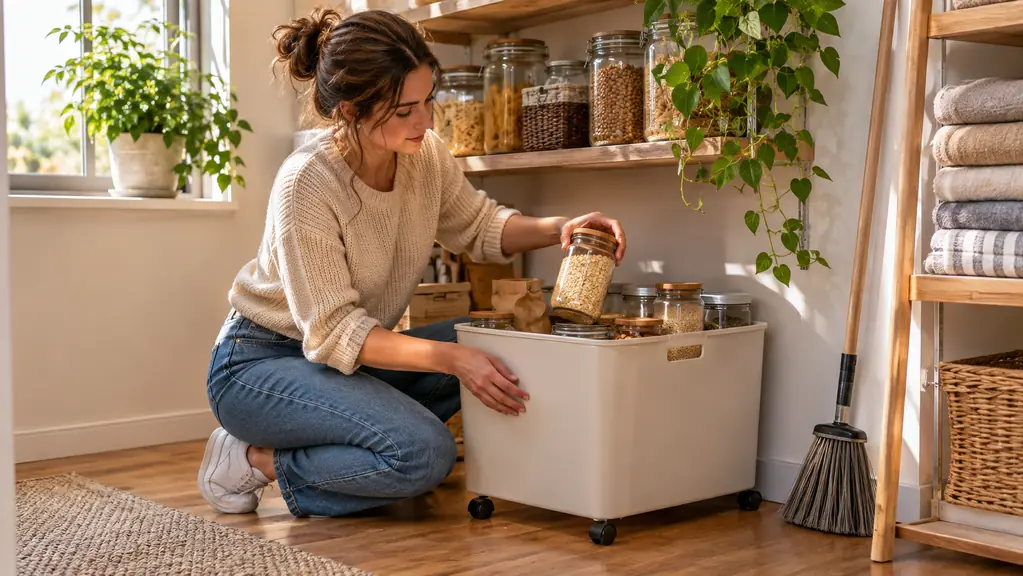
The casters are the redeeming feature. They come attached and you can take them off if you would rather have it sit flat, which drops the height by an inch and a half or so. I have kept mine on because a full bin is not something I want to lift, and rolling it out to the driveway to wash it is the difference between a chore I do and a chore I skip. One practical note from a house with a wood floor: the casters have picked up grit over the years, and I give them a wipe about once a month so they do not grind it into the boards.
The Smell Question, Answered Honestly
People ask whether an airtight bin keeps the food from smelling. I want to separate two things, because they are not the same.
Does the bin keep the smell of kibble out of your pantry? Mostly, yes. When the latches are down, I do not walk into that corner and get hit with a wall of dog food. That was a real change from the open bag. If your issue is the whole room smelling like a feed store, a sealed bin helps and this one seals.
Does the bin keep the food itself fresh longer? The listing says the airtight seals keep moisture and humidity out, and I have no reason to doubt the seal works. But I cannot tell you it extends the life of your kibble, because I have not tested that and I am not going to pretend I have. What I can tell you is what I do: I buy a bag I will finish in a few weeks, I keep the bin closed between meals, and I do not top off an old bag with a new one. I dump the crumbs and wash it between bags. That is the part that is in my control.
The other half of the smell question is the bin itself, and this is where the fiddly part shows up. Even with good kibble, a bin that goes a few weeks will start to smell like the inside of a feed sack when you lift the lid. It does not travel into the room, but it is there. What I do is wash the whole thing out between bags with a mild soap and let it sit open on the porch for an afternoon to dry all the way through before the next bag goes in. Once, when I was in a hurry, I put kibble into a bin that was still damp inside, and by the end of that bag the corners smelled like something I did not want to think about. I did not repeat that.
One thing worth saying plainly. A sealed bin keeps mice out of the food. It does not keep mice out of your garage. If you have a rodent problem, the bin is one line of defense and not the whole answer, and I say that as somebody who learned it the annoying way.
What Nearly Four Years Has and Has Not Done to It
No cracks. No split seams. The latches still snap the way they did the January I brought it home and none of them have gone loose or sloppy. The plastic has not gone brittle or chalky, which is the thing I was actually worried about, because I have had cheap storage tubs go cloudy and crack at the rim after a couple of cold winters in a garage. This one has lived indoors, to be fair, and I would not leave it outside.
The clear body has picked up fine scratches from the scoop and from being washed, and there is a faint haze in the corners where kibble dust collects. Neither bothers me. The wheels have picked up dog hair and dust the way wheels do, and every few months I pull the hair out of the casters with a fork and it rolls smoothly again.
There was one test I did not plan. Two winters back I filled the bin right before a hard cold snap, the kind where the thermometer outside the kitchen window sat below zero for the better part of a week, and I did not move the bin for those days. When it warmed up I popped the latches expecting trouble. The lid came off clean and the seal was intact. What I did notice was a patch of condensation on the inside wall above the food line, which I wiped out before the next scoop. It has not come back since. I mention it because a cold pantry and a warm kitchen on the other side of a door is a real winter condition out here.
The one honest ding is the rim where the lid seats. It is not a removable gasket you can pull out and scrub, so cleaning means getting into a groove with a cloth and a fingernail. It is not difficult, but it is fiddly, and if you are the sort who wants to sanitize everything between bags, budget a few extra minutes for it.
What I Liked
- The snap-lock latches genuinely seal the bin, not just cover it
- Capacity swallows a full bag with room to spare and the translucent body shows the level
- Casters make a full bin movable and can be removed if you want it flat
- Has held up to almost four years of twice-daily use with no cracks or loose latches
- BPA free plastic and hand washing is simple
Where It Falls Short
- The footprint is large and it will not hide in a small kitchen
- A full bin takes two hands to latch and can scoot on its wheels
- The rim where the lid seats is fiddly to clean
- Hand wash only, no dishwasher
- No warranty from the manufacturer, so you are relying on the plastic
Who This Is For
The IRIS USA container is for you if you are buying 30 to 50 lb bags, if you have had a bag torn open by a dog or a mouse, and if you have a corner where a bin can live. It suits a multi-dog house or anyone who buys in bulk and wants to pour the whole bag in at once. It also suits anyone who has gotten tired of folding the top of a kibble bag over and clipping it and still finding it stale.
If you have a pantry and you feed one medium dog, this is probably more bin than you need, and the smaller sizes in the same line will do the same job without taking a corner of your kitchen. That is not a criticism of the product. It is a sizing note, and it is the note I wish I had read.
Who Should Skip It
Skip it if lifting a lid and pressing two latches is hard on your hands. Skip it if you have no floor space and no pantry, because a bin this size that you have to walk around every day will wear on you. Skip it if you want something you can put in the dishwasher between bags, because you cannot with this one.
And skip it if you are hoping a bin will fix a food problem. It will not. If your dog has a sensitive stomach or is gaining weight or is slowing down on cold mornings, that is a conversation with your vet, not a storage decision. The bin keeps the food dry and the mice out. That is the whole job, and it does the job.
One more thing I tell anyone who asks, and then I will get out of the way. Wash the bin between bags and do not pour fresh kibble on top of the old stuff at the bottom. It takes five minutes and it is the difference between a bin that helps and a bin that is just a place where old food sits. The IRIS USA container makes that easy because the whole thing rolls out to the driveway. Whether you do it is on you.
Four years in, I bought the same bin again
If you are tired of the folded-over bag and the garage mice, this is the size and the seal that solved it here. Measure your corner first, then check today's price.
Amazon Check Today's Price on Amazon →