
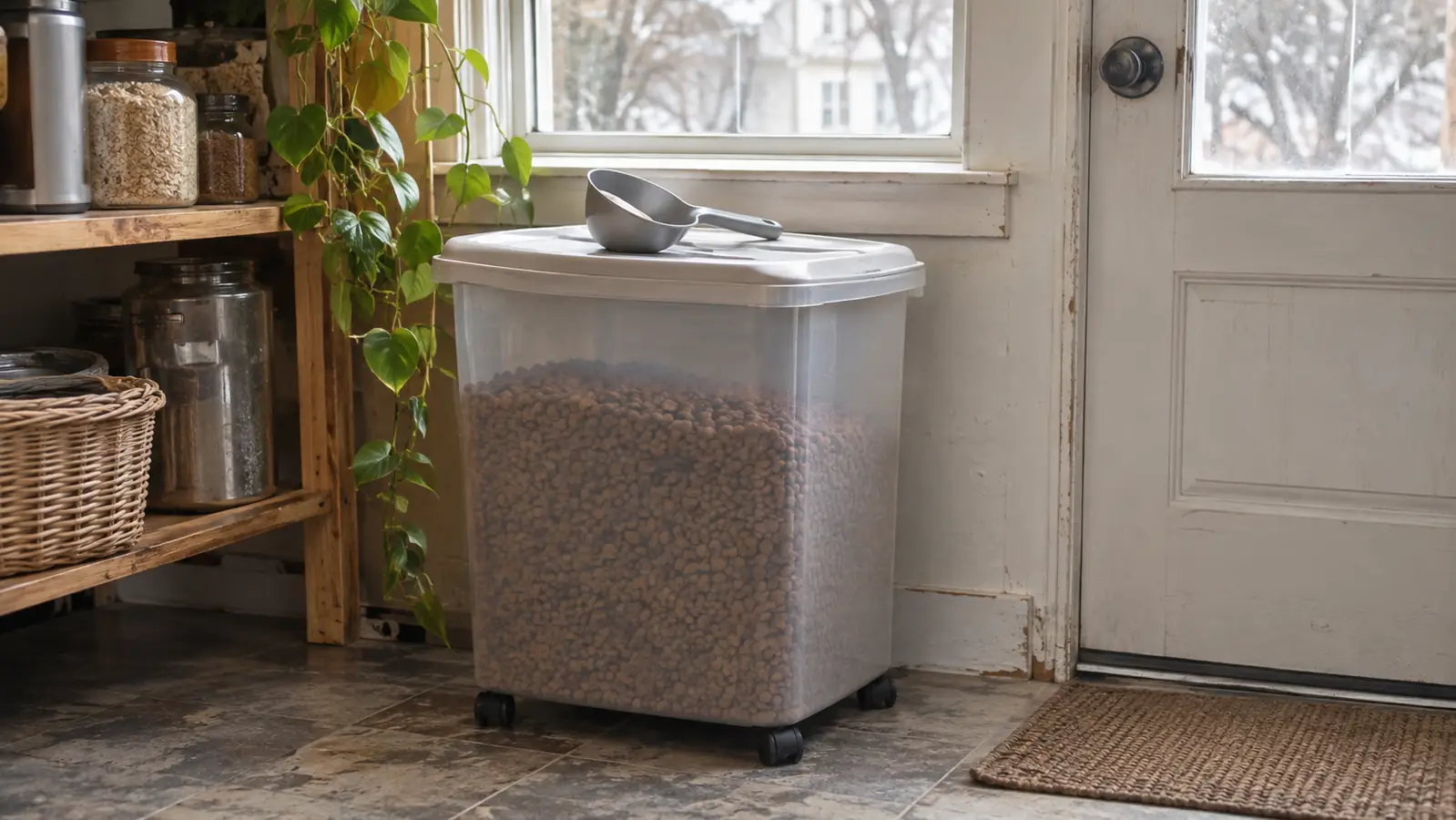
The kibble bag lived in the garage for years, and for years that was fine. Then one January morning I walked out for the scoop and found a hole chewed in the side of the bag, a trail of kibble across the concrete, and a smell I will not describe to you. I threw out most of a bag, scrubbed the shelf twice, and drove into town for something with a lid that shut. That is how the IRIS USA dog food storage container ended up in my pantry by the back door, and it has been there ever since. Almost four years now.
Juniper is ten this fall. She is a Golden, about 64 pounds, with a white muzzle that showed up around the time she turned eight and started moving stiff on cold mornings. She also has a sensitive stomach, which means a bag of food that goes stale or picks up a smell is not a small problem in this house. It is a week of three in the morning trips to the back door. So the container was never really about the mice. The mice just made me do something about it. Keeping a large bag of kibble genuinely fresh for weeks at a stretch matters more than most people give it credit for, and the bin turned out to be the cheapest part of that equation. I am not a vet and I am not going to pretend to be one. I am a woman with a pantry and one dog and about twelve years of looking after other people's dogs around Bozeman, Montana. This is what four years of daily use looks like.
The Quick Verdict
Bought to keep mice out of the kibble. Kept because the seal works and the wheels save my back. Ugly, scratched, heavy when full, and I would buy it again tomorrow.
Amazon Check Today's Price →The mice got in once. Four years later they have not gotten in again.
54 pounds of dry food, four snap-lock latches, casters you can leave off, and a body you can see through from across the kitchen. Mine has been on the same pantry floor since January 2023.
Amazon Check Today's Price on Amazon →How I've Used It
The routine has not changed in four years. I buy a 15 pound bag of Juniper's food about every three weeks, bring it home, and dump the whole thing in. A 15 pound bag sinks into the lower part of a bin built for 54 pounds, so the container is always holding more than one bag. I am never scraping the bottom and I am never one bad week away from an empty bin. The IRIS USA bin has run through somewhere north of sixty bags in that time.
There is a cheap plastic scoop that lives inside, and the lid pulls down on four latches. Breakfast is at seven, dinner at five, two level scoops, and the amount is whatever the bag and my vet say it is, which is not always the same as whatever I think it should be. Twice a day I open it, scoop, and close it. That is the entire relationship.
Between bags I take it outside, dump the crumbs, and hand wash it in the utility sink with dish soap and a rag. Hand wash only is stamped on it and I have not tested what a dishwasher would do to it. Four years in, it does not smell like old dog food. That is the part I did not expect. A bag left open in a garage smells like a bag left open in a garage. This does not.
It sits on its wheels on a tile floor by the back door, and I roll it out to sweep under it once a week. Twelve years of house sitting taught me that the floor under the food bin is where every crumb in the house eventually ends up. Wheels turn that from a two minute job into a ten second one.
What the Latch and the Seal Actually Do
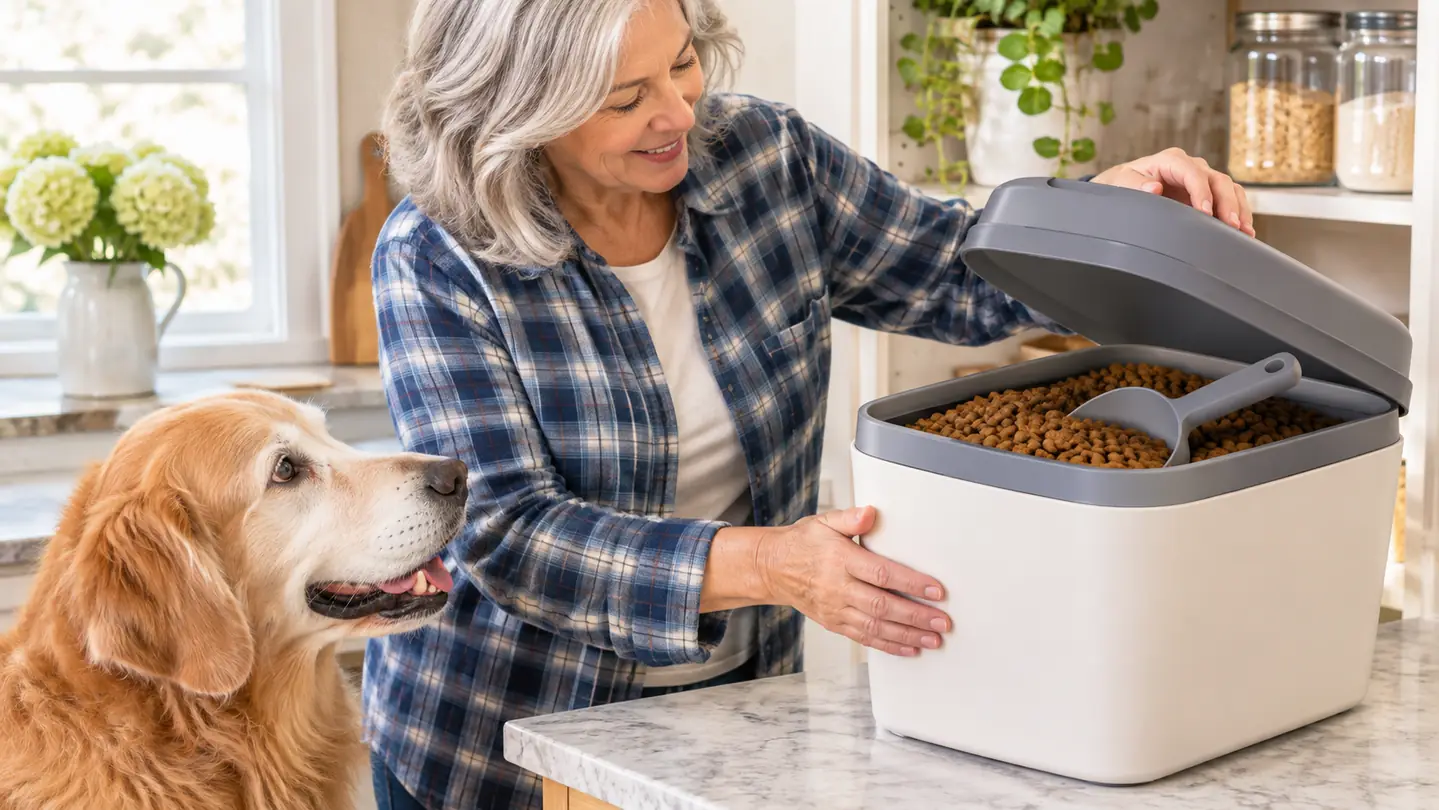
The lid is one piece and it lifts off when you flip the four latches. There is no hinge, which is the first annoyance and I will get to it. What matters is the seal. There is a gasket set into the lid, and the snap locks pull it down evenly on all four sides. The listing describes airtight seals and snap-lock latches that keep moisture and humidity out, and after four Montana winters I believe it.
I have had kibble go soft in a garage. You can tell by the smell before you can tell by anything else, and Juniper can tell before I can. She will sniff a bowl and walk away from it, which for a Golden Retriever is close to a medical event. In almost four years in this bin I have not lost a bag, and I have not had a single morning where she turned her nose up at breakfast.
The mice did come back the next winter. They got into a bag of birdseed in the garage, which is a separate lesson about birdseed. They did not get into the bin. The latches held, the plastic held, and I have not found droppings in a dog food container since.
The Casters Are the Feature I Underrated
The bin comes with attachable casters. The listing says you can run it with them off or on. I put them on the first day and have never taken them off.
The footprint is 17.98 inches long, 14.76 inches wide, and 23.44 inches tall with the casters on. Without them it stands 21.88 inches tall. I am five foot four, so that difference is not academic. When the bin is full and I am reaching the bottom of it, two and a half inches is the difference between a scoop and a full lean over the rim.
The wheels are small and hard. They roll well on tile and badly on a rug, and there is no brake, so a hard shove into a corner will send it drifting back out at you. Empty, the bin weighs 4.8 pounds and I can pick it up by the rim. Full, I do not try, and I do not need to.
The See-Through Body, and What It Costs
The body is translucent, so the food level is one glance away. I did not think this would matter and it matters every day. I can see from the far side of the kitchen whether I am good until the weekend or whether a bag needs to go on the list.
The trade is that a translucent bin shows everything. Four years of scooping has left fine scratches inside from the scoop and from kibble corners. There is a faint tideline of dust where the lid meets the rim. If you want the pantry to look like a pantry in a magazine, this is not that object. It is a working bin and it looks like one.
The plastic is BPA free, which is the kind of label I started reading in a school cafeteria and never stopped reading. It is also made in the USA. Neither of those facts changed my life. Both were on the list of reasons I picked it over a bucket.
The Annoyances, Four Years In
The lid has no hinge. You flip four latches, lift the whole lid off, and then you need somewhere to put it. I set it upside down on the counter, which means the inside of the lid is now touching a counter, which means I wipe the counter again. A hinged lid would be a better design. Years of running a school kitchen left me fussy about lids.
There is no warranty. The manufacturer's information says so plainly, and I would rather read that than a paragraph of vague promise. You are buying a plastic bin, not a guarantee.
The casters collect hair. So does the recessed lip under the rim. So does the seam where the lid sits. I keep a vacuum attachment near the pantry and hit all three once a week. If you have a long haired dog and a small kitchen, plan for that.
And when the bin gets down to the last few cups, you are reaching into the bottom of a 23 inch tall box with a scoop. There is no clever way around it. I have learned to put the next bag on the list when I can see the low line, rather than waiting until I can feel it.
What It Doesn't Do
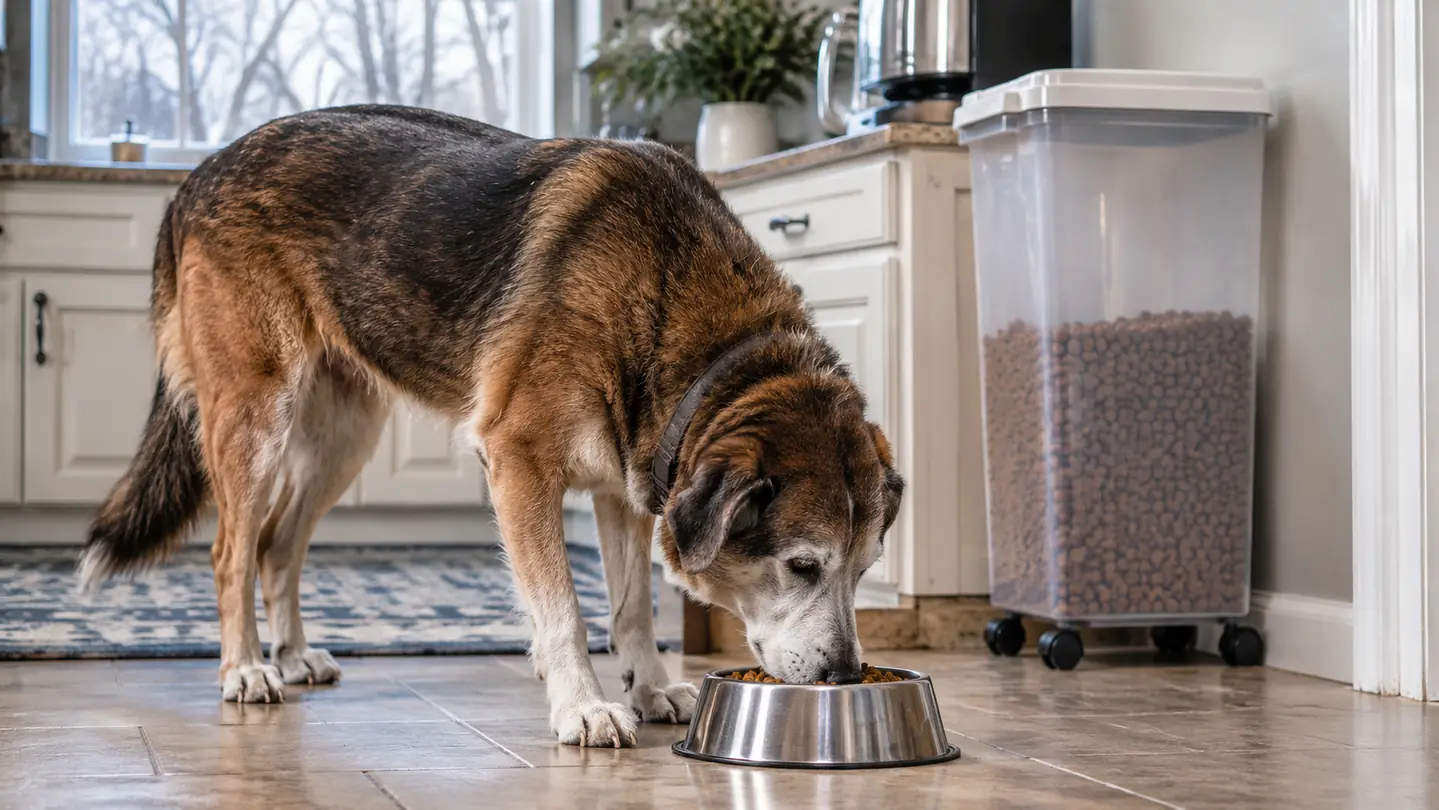
It does not keep the food fresh forever, and it does not tell you when the food has aged. I write the date I open a bag on the lid with a dry erase marker, which is a habit from the cafeteria and not a feature of the bin. It also does not stop a dog from getting into it if you leave the latches up. Juniper has never tried. A client's Labrador I sat for two winters ago would have tried, and I would not have trusted a plastic latch against him.
It does not go in the dishwasher, it does not nest inside anything, and it does not stack. It is a single-purpose object taking up a footprint of roughly a foot and a half by a foot and a quarter in your pantry. Measure that space before you order.
What I Compared It To
I looked at a Vittles Vault, which is the other bin people bring up, and I have written about that comparison separately. I also considered the two things people actually do: keep the bag and clip it, or pour the bag into a five gallon bucket. I have done both. A clipped bag in a garage is a bag in a garage. A bucket holds maybe a third of a bag, it is not on wheels, and the lid is a misery to get off with cold hands in February.
The reason I bought the IRIS USA bin and not something fancier is that I wanted to pour and forget. I did not want a lid I had to line up, a seal I had to seat by hand, or a container that needed a second container inside it. This is a rectangular plastic box with four latches and wheels. That is the whole idea, and four years later it is still the whole idea.
What I Liked
- Airtight seal and four snap latches: no stale kibble in almost four years
- Holds a full 54 pounds, so a 15 pound bag disappears into it and I am never near empty
- Casters come with it and can be left off; I roll it out to sweep under it weekly
- Translucent body means one look tells me what I have left
- Hand washing takes five minutes between bags and it has never held a smell
Where It Falls Short
- Lid is one piece with no hinge, so you need a free hand to set it down
- No warranty listed, and the plastic does scratch
- Small hard casters roll badly on rugs and there is no brake
- Reaching the last few cups means leaning into a 23 inch tall box
- Casters, seams, and the lip under the rim all collect dog hair
A bag left open in a garage smells like a bag left open in a garage. Four years in, this bin does not smell like anything.
Who This Is For
If you buy dry food in bags larger than a week's worth, this is the shape of the problem it solves. It is for the person with a pantry corner and a floor that can take a wheel, who wants to open a lid with one hand and not think about it again. It is for anyone who has ever thrown out half a bag because something got into it, or because it went soft before the dog got to the bottom. It is for a household with one dog who eats the same food twice a day, which is most of us.
It is also for people who feed a dog with a sensitive stomach. Juniper's gut has opinions about stale food and about sudden changes, and I have enough to manage with a measured scoop and a slow transition between bags without adding a freshness variable on top of it.
Who Should Skip It
Skip it if your pantry is shallow, because this thing is nearly two feet tall and it needs the clearance for the lid to come off. Skip it if you feed raw, or if you buy food in small bags that you use up inside a week, because you are paying for capacity you will not use. Skip it if you need a lid that hinges or a container that stacks. And skip it if you are looking for something that will look tidy in an open kitchen, because it will not.
Four years, sixty-odd bags, and one chewed bag of birdseed I am still annoyed about.
If your kibble lives in a garage or in an open bag on the floor, this is the fix I landed on. 54 pounds of capacity, four latches, casters included, hand wash between bags.
Amazon Check Today's Price on Amazon →