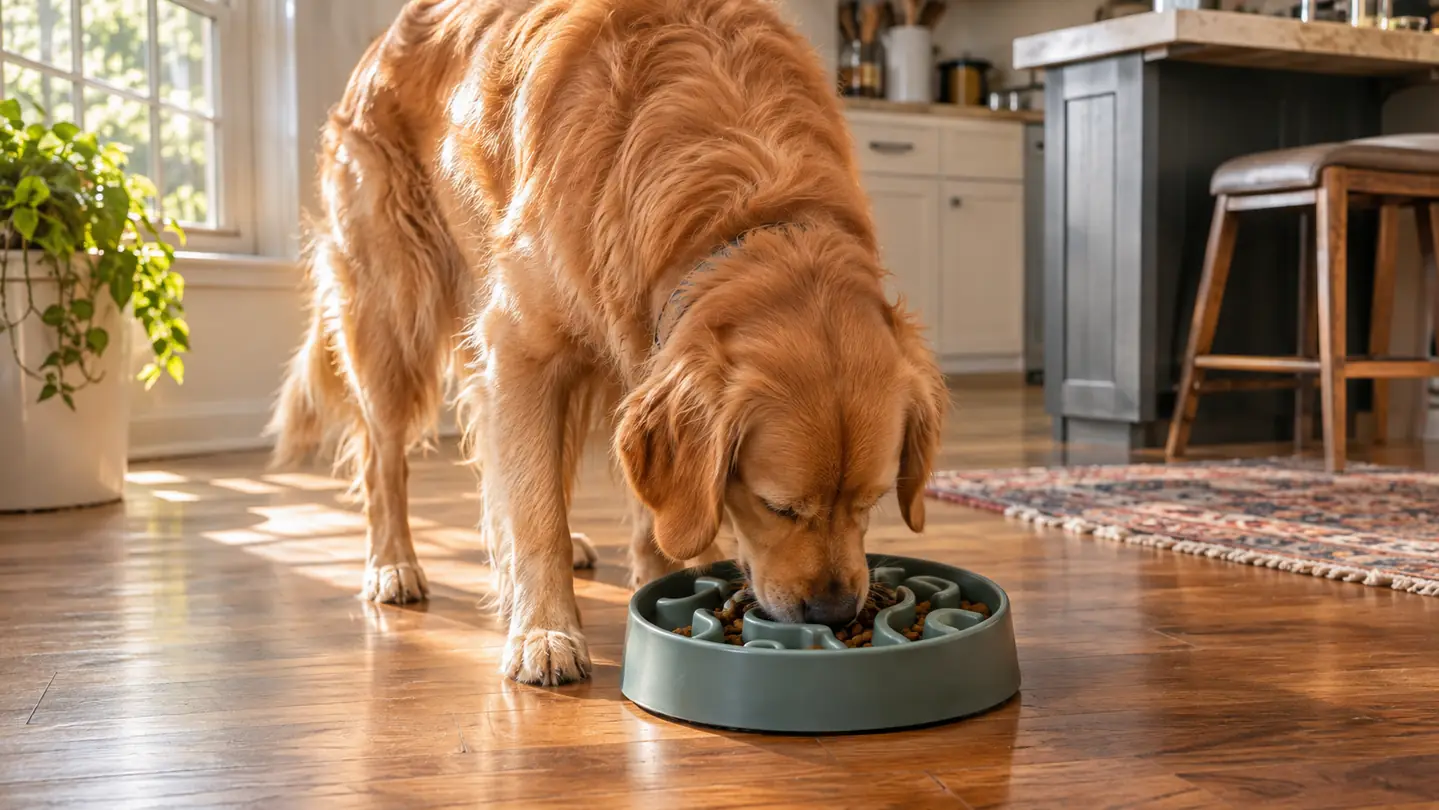
The first time I timed Juniper eating dinner, she did it in about forty-five seconds. A full meal, gone, and then she stood over the bowl and looked at me like I had shorted her. Twice that month, dinner came back up on the kitchen floor, whole kibble and all. She was not sick. She was eating faster than her stomach could keep up with, and I had been standing in the kitchen watching it happen for months without doing a thing about it.
That is the point where most people start looking at bowls. I did. I bought an Outward Hound Fun Feeder in March 2024 and I have fed both of her meals out of it every day since, which puts us at about two and a half years. What follows is the process I would hand to someone standing in my kitchen asking how to slow a dog down, including the parts I got wrong in the first week. I am not a vet. I am a woman who has fed a lot of other people's dogs and one very determined Golden Retriever with a white muzzle and strong opinions about breakfast.
Forty-five seconds of dinner became several minutes of dinner. Same kibble, same dog, one different bowl.
The Outward Hound Fun Feeder holds 4 cups of dry or wet food and comes in three maze difficulty levels: Slow, Slower and Slowest. This Drop pattern is the Slowest level, built for dogs who inhale rather than chew.
Amazon Check Today's Price on Amazon →Step 1: Rule out a medical reason before you buy anything
Before you spend anything, decide whether this is a habit or a symptom. A dog who has always eaten fast is usually just a dog who eats fast. A dog who suddenly starts gulping after years of picking at her food, or who is gulping and losing weight, or who brings meals back up more than once in a while, is a different conversation. That one belongs to your vet, not to a bowl.
With Juniper I had a baseline. She had always been quick, and she had been through her yearly exam that winter with nothing flagged. When I mentioned the food coming back up, my vet's office asked the obvious questions about timing and about how fast she was actually eating, and I did not have a good answer because I had never timed it. So time it. Sit down with a phone and clock one meal. Forty-five seconds is the number I got, and it is the number that made me act instead of shrug.
Two more things I would not skip past. If your dog guards the bowl, snaps when you walk by it, or has ever had an episode of bloat, treat those as separate problems and talk to your vet before you change equipment. A slow feeder is a feeding tool. It is not a fix for a medical issue and it is not a fix for resource guarding, and pretending otherwise is how people end up blaming a piece of plastic for something it was never going to solve.
Step 2: Match the bowl to the meal, not to the dog's size
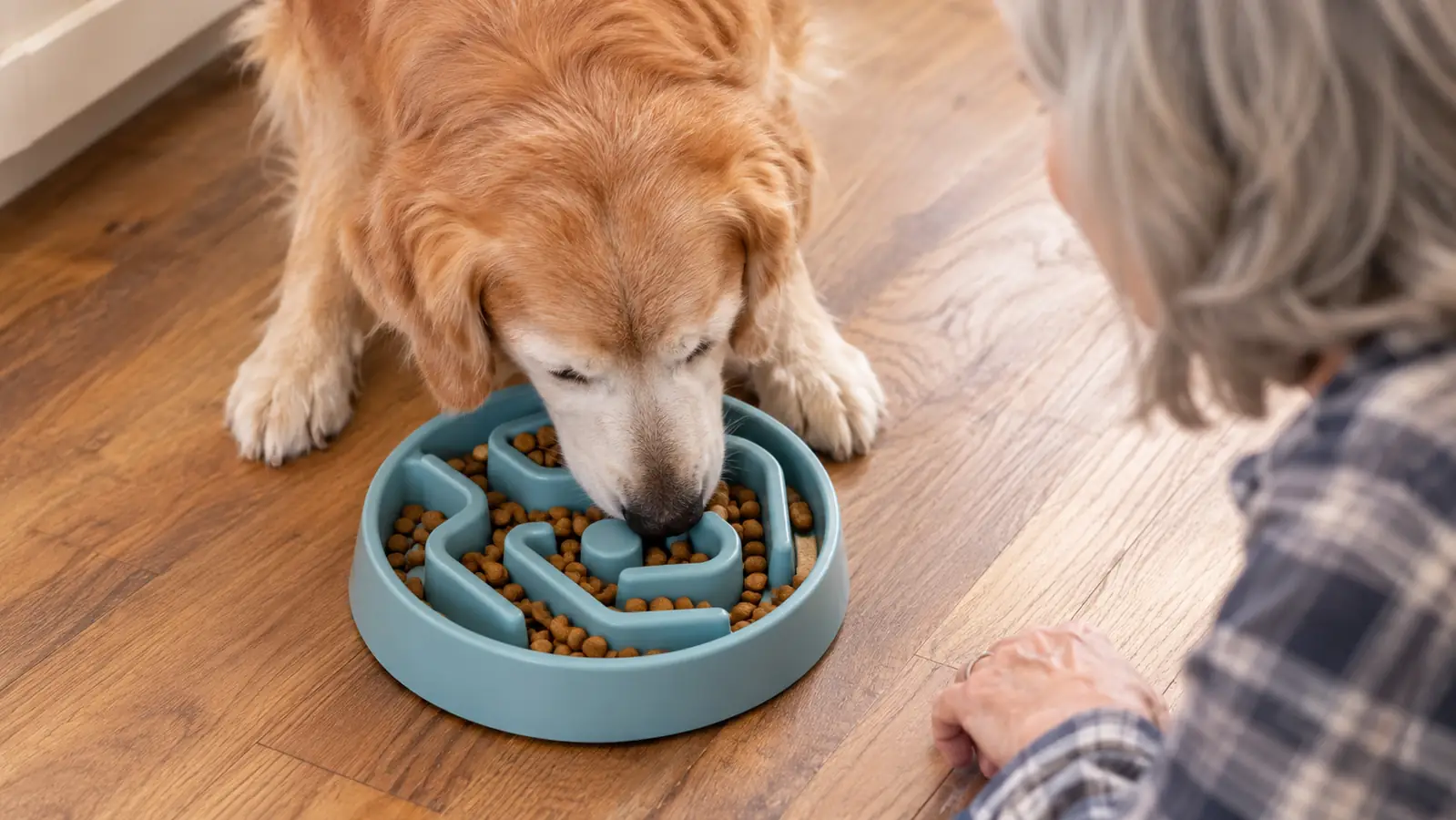
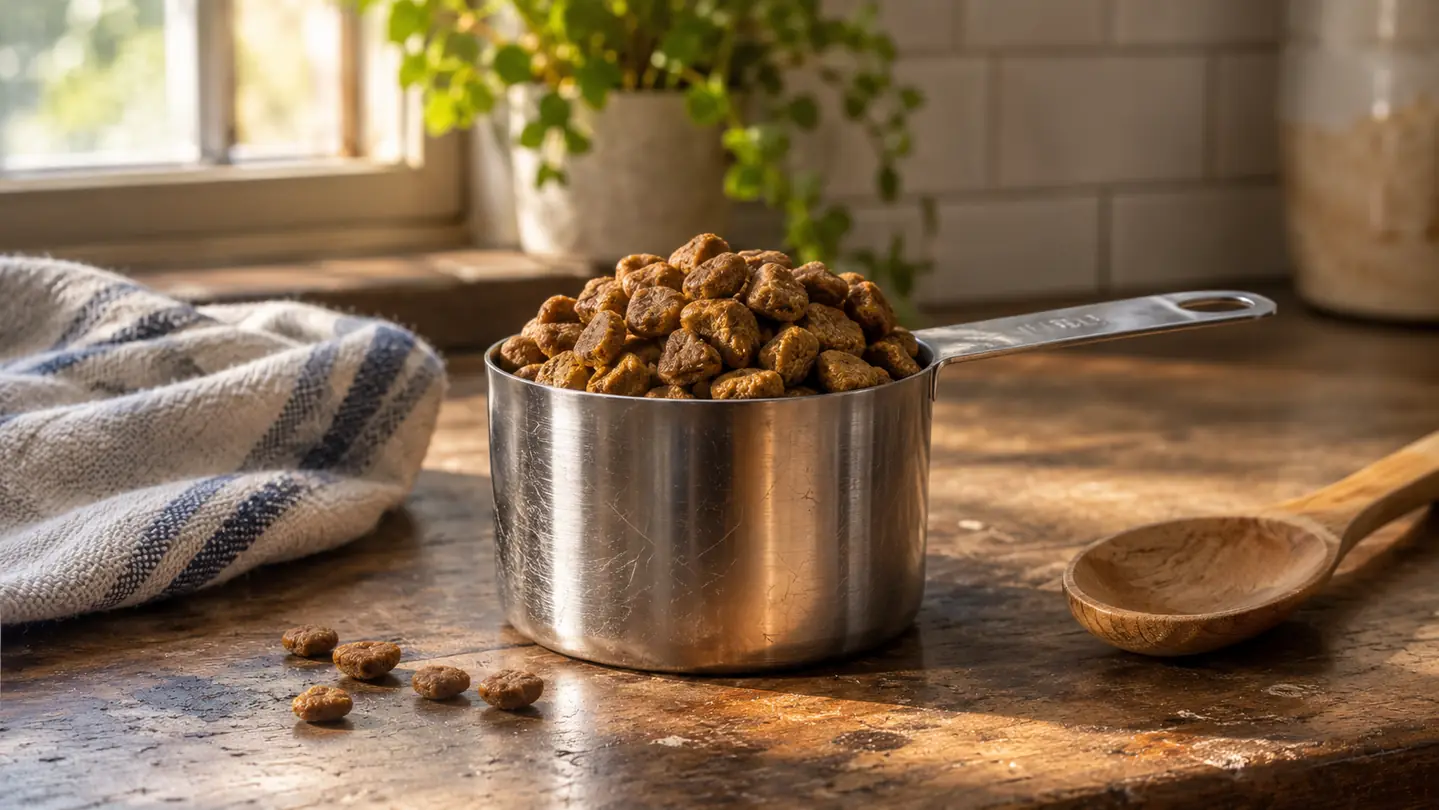
The Fun Feeder holds 4 cups, and it measures 11.81 inches across and 2.69 inches tall. That is a real footprint on the floor, which matters more than you would think in a small kitchen. Mine takes up a genuine square of floor space by the back door. Before you order, measure the actual meal you serve. Juniper gets measured cups twice a day, breakfast around seven and dinner around five, and her portion sits well under the bowl's capacity. That is the whole point. A slow feeder you fill to the brim is a slow feeder that stops slowing anything down.
The bowl is plastic and weighs about fifteen ounces when it is empty, so it is not going anywhere on its own, but nothing is holding it down either. It sits on the floor on the strength of its own weight and the weight of the food in it. A dog who shoves the bowl across the kitchen with her nose will still shove this one across the kitchen. Juniper pushes hers a few inches and then gets back to work. If your dog is a shover, put the bowl in a corner or against a wall so it has something to run into, and think twice about feeding on bare hardwood.
One more sizing note, and then I will leave it alone. The listing recommends the Outward Hound bowl for all breed sizes, and I believe that about the bowl. I do not believe it about the dog. A four-cup maze is a lot of real estate for a ten pound dog, and an eleven and three quarter inch bowl is not much of a puzzle for a dog with a muzzle the size of my hand. Judge by how much your dog eats in one sitting and how much floor you are willing to give up.
Step 3: Pick the maze level your dog actually needs
Outward Hound makes this bowl in three slow levels, labeled Slow, Slower and Slowest, with different maze patterns in each. The Drop pattern I use is the Slowest level, which the listing says is meant for very fast eaters and can stretch a meal out by up to ten times. That matched my dog exactly. If your dog is a moderate eater, or a dog who gets frustrated and walks away from a challenge, starting at the hardest level can backfire on you. A dog who gives up on dinner is not being slowed down. She is being put off her food, which is a much worse problem than a fast meal.
The honest test is one meal. Put the usual portion in and watch, and do not narrate. If your dog works at it steadily, sniffs, backs up, tries the edges, and keeps going, the level is right. If she noses it for thirty seconds and wanders off, it is too hard, and you either drop to a gentler level or scatter a little kibble across the top to get her started. Juniper's very first attempt took her a while to figure out, and by the third meal she had a route she liked.
If you land on the right level and your dog gets quick at it again after a few months, the same bowl comes in other maze patterns at the same three levels. Changing the pattern gives an old hand a new route without changing the amount of food, the times, or anything else in her day. I have not needed to do it, because dinner still takes Juniper several minutes and she still has to think about it.
Step 4: Introduce it at a calm meal, not a rushed one
Do not debut a puzzle bowl at a meal when you are walking out the door. Do it on a day you are home, at the normal time, in the normal spot. Same kibble, same amount, same corner of the kitchen. The only thing that changes is the dish. Dogs read change as change, and everything else staying exactly where it always is tells them this is still dinner and not some event.
The first few meals, stay in the room. Not hovering over her, just present. The two failure modes I have seen are the dog who tries to flip the bowl and the dog who tries to eat around the maze by pushing kibble out onto the floor. The flipping tends to sort itself out once the channels are loaded and the bowl is heavy. The pushing food onto the floor is a habit worth interrupting early, because once kibble is on the floor the bowl is no longer doing the job you bought it for.
Expect a mess the first week. Kibble comes out of the channels and lands on the floor, and if your dog is a messy eater you will sweep more than you used to. That trade has been worth it to me. Two and a half years in, I sweep the same small square of floor every evening and I have stopped noticing I am doing it.
Step 5: Wash it by hand and keep the rest of the routine boring
The bowl goes in the sink most days. Warm water, a drop of dish soap, and a brush that actually reaches down into the channels, because fingers do not. Rinse it well and stand it up to dry. I have washed it by hand the whole time I have had it. Wet food in a maze bowl is the case that will test you, since wet food sits in the channels in a way dry kibble does not, so if you feed wet, wash it after every single meal without exception and get a brush with a stiff head.
Check it now and then for cracks, especially along the raised ridges, because it is plastic and plastic does not last forever if you drop it on tile. Juniper has never chewed hers, so the Outward Hound bowl is still in one piece after about two and a half years. A dog who does chew will make short work of the maze, and a chewed bowl with sharp edges is a bowl to throw out the same day you find it.
Keep everything else the same. Two meals, same times, same measured amount, a walk in the morning and the shorter one in the evening. The bowl is one variable. If you change the food, the schedule and the dish in the same week, you will not know which one did anything, and you will be starting over from a mess of variables.
What Else Helps
A slow feeder fixes the speed of the meal. It does not fix the reason some dogs eat like the floor is about to open up. Portion size is the bigger lever, and it is the one I have been most careful about. Juniper gets measured cups, twice a day, and the amount comes off the bag and out of conversations with my vet. She lost a few extra pounds after I started measuring instead of eyeballing, and she moves better for it. A dog carrying extra weight is a dog with more strain on old joints, and that matters more at ten than it did at five.
Timing helps too. A walk before dinner, a quiet corner, no competition at the bowl. Juniper is an only dog, so I do not have a crowd to manage, but I have sat for dogs who had to be fed in separate rooms and it made a difference for all of them. If there is another animal in your house, feed them apart and out of sight of each other. Fast eating gets faster when a dog thinks someone is coming for her food.
And keep the yearly exam on the calendar. Mine is a local vet I have gone to for years, and every checkup is a chance to mention what I have noticed at home: the stiff cold mornings, the weight, the speed of a meal, a coat that has gone dry and flaky over the winter. None of that is a diagnosis. It is information the vet can use. Then follow the label on anything you add to the bowl, and ask before you change the amount.
Dinner went from forty-five seconds to several minutes. Same dog, same kibble, one different bowl, and a sweeping habit I have stopped noticing.
If your dog is finished eating before you sit down, start with the bowl and time one meal tonight.
The Outward Hound Fun Feeder holds 4 cups of dry or wet food and comes in three slow levels, Slow, Slower and Slowest. After about two and a half years of twice-daily meals, mine is still in one piece and still doing the job it was bought for.
Amazon Check Today's Price on Amazon →