

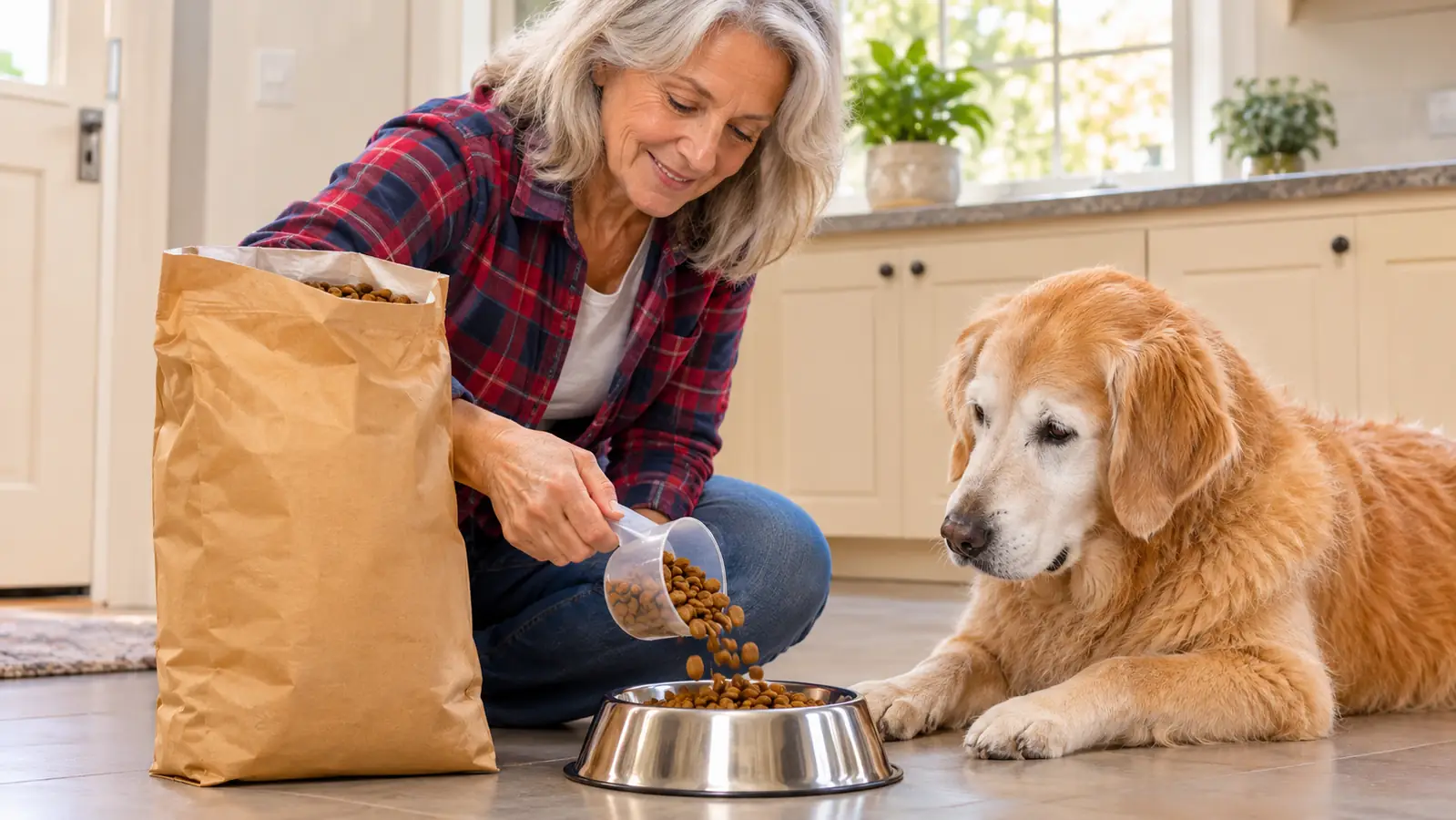
Juniper turned ten this fall. She is a Golden Retriever, sixty four pounds, with a muzzle that has gone nearly white, and she has slowed down the way an old dog does. Stiff on cold mornings. A little extra weight around the middle. A stomach that files a formal complaint if I change her food too fast.
Blue Buffalo Life Protection Formula Senior 7+, the chicken and brown rice bag, went into her bowl in February 2025. That is about a year and nine months of twice-a-day meals, measured with a cup, out of fifteen pound bags I buy roughly every three weeks. The other bag people ask me about is Purina Pro Plan Senior, and I have stood in the store and read that label more than once. Here is the short answer, then the honest long one.
Short answer: I feed Blue Buffalo, I have kept feeding it, and I would buy it again. The reason is the ingredient panel, not a promise printed on the front. It is corn-free, wheat-free and soy-free, and real chicken is the first ingredient named. Purina Pro Plan Senior is a decent food from a company that tests its formulas, and it wins on a few things I will not pretend it does not. Which one belongs in your bin depends on your dog and on your week.
| Blue Buffalo Senior 7+ | Purina Pro Plan Senior | |
|---|---|---|
| First ingredient | Real chicken, named, at the top of the list | Real chicken, named first on their chicken and rice senior formula |
| Corn, wheat and soy | None of the three. The listing says corn-free, wheat-free and soy-free | Corn and wheat show up on the ingredient panels of their senior formulas |
| Bag sizes | The fifteen pound bag, sized for one dog eating through it in about three weeks | Several sizes, including bags big enough for a two dog house |
| Senior extras | The listing says the formula supports joint health in senior dogs, with LifeSource Bits carrying the antioxidant blend | Their 7+ formulas add ingredients aimed at cognitive support in older dogs |
| Where you can buy it | Online, and at the pet store in town | Grocery stores, big-box stores and the feed store |
| Feeding trial language | The listing covers the ingredient panel and joint support, with no feeding trial claim on it | The company says its diets go through feeding trials and prints that on the bag |
| Best for | Dogs with sensitive stomachs, and people who read the whole panel | Dogs doing fine on a mainstream formula, and households that need it in town today |
Where Blue Buffalo Wins
I managed a school cafeteria for years before I ever did pet sitting, and that job is where I learned that the back of a package tells you more than the front ever will. The front of the Blue Buffalo bag talks about senior years and vitality. The back is where I made my decision. No corn, no wheat, no soy, and chicken is the first thing named on the list.
The second thing, because people ask me about it at the mailbox: those small dark pieces mixed through the kibble. The listing calls them LifeSource Bits, a blend of antioxidants, vitamins and minerals. Juniper noses some of them out and leaves them in the bowl, which I mention because a review that pretends a dog eats every last piece is not much of a review. What I can tell you is that the listing says this formula supports joint health in senior dogs, and at ten years old with stiff mornings, that was the claim I was shopping for. I still do not expect a bag of food to do the work of a walk.
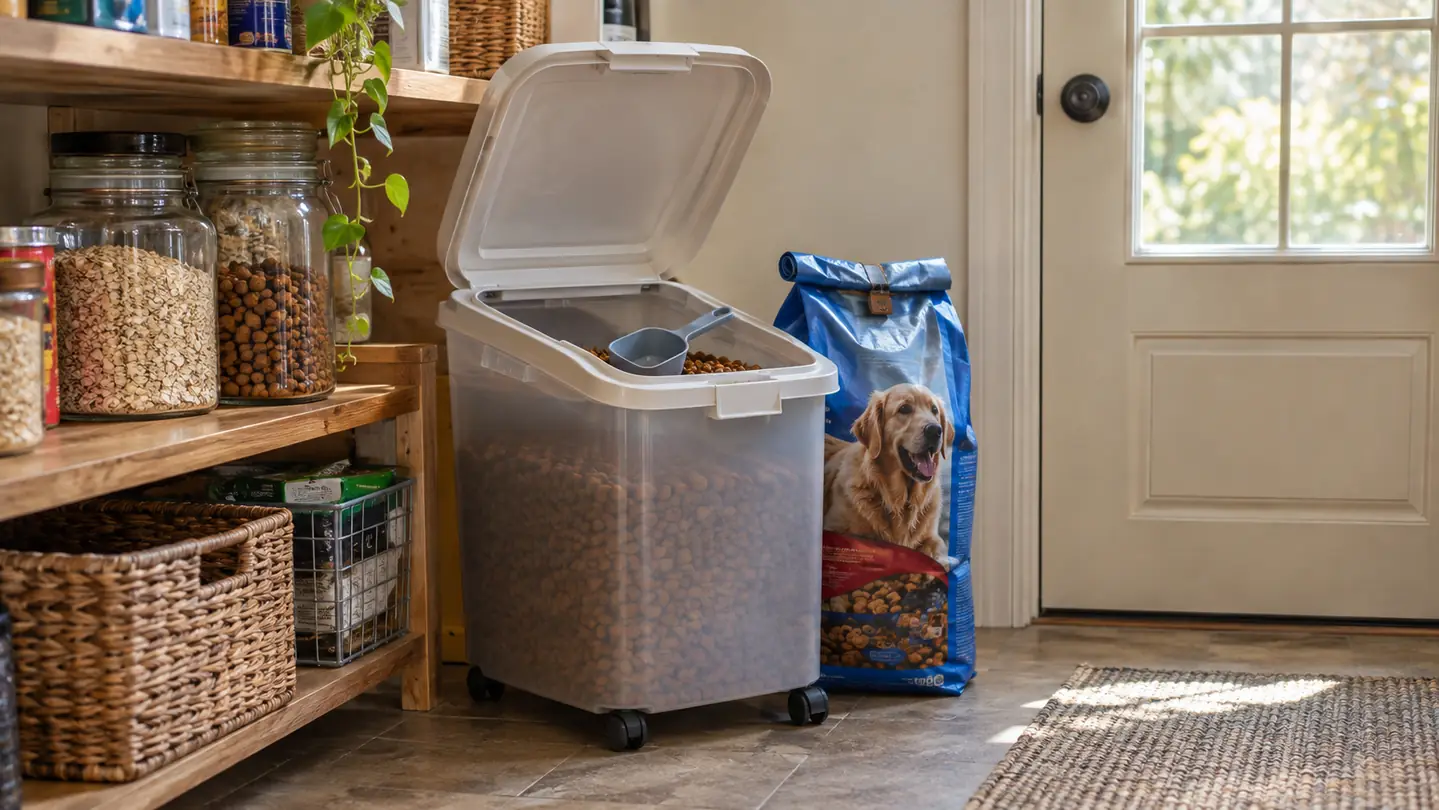
The fifteen pound bag is also the right size for one dog. Three weeks, roughly, from open to empty, which means the food at the bottom of the bag is still reasonably fresh when I get to it. I pour the whole bag into a lidded container in the pantry by the back door and scoop from that, and I hand-wash the container between bags. A bigger bag would be cheaper per pound and staler by the end. For a single sixty four pound dog, this one is the fit.
I measure with a one cup scoop and level it off with the back of a knife, which sounds fussier than it is. The kibble is a pellet, small enough that an old dog does not have to work at it, and I have never once had to soften it or add water to it. Between container fills, the bag gets rolled shut and clipped with a chip clip in the pantry drawer. Almost four years of keeping kibble that way, first in the old container and now in this routine, and I have never had a bag go off on me. If a dog turns her nose up at dinner, stale food is the first thing I check before I blame anything else.
Where Purina Pro Plan Wins
I am not going to pretend the other bag is a bad choice, because it is not. Pro Plan is made by a company that says its diets go through feeding trials and prints that fact on the packaging. When you are standing in an aisle trying to decide between two bags, a claim like that is worth something, and I would rather tell you so than talk it down.
It is also everywhere. If I run out on a Sunday afternoon in November, the grocery store in town has Pro Plan on the shelf and it very likely does not have what I feed. That sounds like a small thing until the first ice storm closes the road to the pet store. Their senior 7+ formulas also add ingredients aimed at cognitive support for older dogs, while mine is built around joint support. If your main worry is a dog who seems confused and restless in the evenings rather than stiff in the mornings, that is a real difference and one worth taking to your own vet.
One more point in their favor: they make more than one senior formula, so there is somewhere to go as your dog gets older. Consistency matters with an old dog, and a big brand tends to deliver the same bag every time. If you have two large dogs eating through forty pounds a month, that reliability and that shelf presence count for more than any single ingredient line.
What I will say for a big brand is that the bag is the same bag every time. I have stood in that aisle with a list in my hand and picked up the Pro Plan senior bag more than once, read it front and back, put it down, and picked up what I came for instead. That is not a knock on it. That is what a person does when she has one dog, a sensitive stomach to work around, and a bag at home that is already working. The thing that would actually move me is a reason, and for a dog losing her bearings in the evening rather than her spring on the stairs, that reason exists, and it is worth asking your vet about specifically.
The bag that has been in my pantry since February 2025
Blue Buffalo Life Protection Formula Senior 7+, chicken and brown rice, fifteen pounds. Corn-free, wheat-free, soy-free, with real chicken first on the list. It is the one I put in Juniper's bowl twice a day, measured with a cup, and it is the one I would buy again tomorrow.
Amazon Check Today's Price on Amazon →The Ten Day Switch, and Why I Went Slow
Juniper has a sensitive stomach. That is not a guess or a hobbyhorse of mine, it is something I learned the hard way when she was younger and I swapped her food in a single afternoon. So when I moved her onto this bag in February 2025, I did it over about ten days. A quarter of the new food mixed through the old for a few days, then half and half, then three quarters, then all of it. Same bowl, same times, breakfast around seven and dinner around five.
Day by day it went like this. Three quarters of a cup of the old food with a quarter cup of the new for three mornings. Then half and half for three. Then three quarters new for three more, and on the tenth morning the bowl was all new food and she ate it the same as always. I wrote the dates on the calendar on the wall by the phone, the way I write everything down, because by day five I could not have told you where I was in the switch without it. The one morning she hesitated, day four, she was hesitating over a noise in the driveway, not the food. I still stood there in my robe and watched her finish it.
She never noticed. No loose stools, no refusal, no three in the morning wake-up. That is the least dramatic sentence in this whole article and it is the one I would want if I were you, because a food that suits your dog on paper and upsets her stomach is not a food that suits her at all.
The other change I made at the same time was portioning. I measure with a cup, per the bag and per my vet, and I stopped topping the bowl up out of habit. Over those first months she lost a few extra pounds, partly from measured meals and partly from more walking. That mattered more than the bag did. An old dog carrying less weight on stiff hips is a dog who moves more easily, and no formula in the world replaces that.
I switched her over ten days, a quarter of the new food at a time, and her stomach never noticed. That is the most useful thing I can tell you about either bag.
What I Watch For Now
I am not a vet and I am not going to write like one. What I do is watch the same four things every week: how eagerly she eats, what her stools look like, whether her coat feels dry or greasy, and whether she is up and moving on a cold morning or hesitating at the door. If any of those slide, the food is not automatically the suspect. It could be the weather, it could be her teeth, it could be something only a vet can find. I write it down and I take the list to her yearly checkup.
The notebook lives on the counter by the coffee maker and it has four columns and a lot of blank weeks in it. Most weeks I write nothing, because nothing changes, and that is rather the point of keeping it. The winter before last we had a stretch of ice on the driveway that lasted eleven days, and I wrote something every single morning of it. Not because I thought the food was the problem, but because a stiff dog on ice tells you more about her joints than any label on any bag. Then I took the page to her checkup and let the vet read it instead of me trying to remember.
For what it is worth, the rest of her routine has stayed the same for a while now. She gets a joint supplement chewable at breakfast, which she has had for about two years, with dosing per the label and per my vet, and she seems to get going a little easier on cold mornings. She gets a pump of liquid fish oil over her kibble, which started about a year and a half ago after a dry winter coat, and her coat looks shinier to me. I do not claim either one fixes anything. Food, walks, a warm bed and keeping her weight down are the bulk of it.
Who Should Buy Which
Buy the Blue Buffalo Senior 7+ if you have one dog, if you read ingredient panels, and if corn, wheat and soy are the things you would rather not see in the bowl. Buy it if your dog has a sensitive stomach and you are willing to make the switch over ten days instead of one afternoon. Buy it if a fifteen pound bag roughly every three weeks suits how you shop, and if you keep the food in a sealed container so the last scoop is as good as the first one.
Buy the Purina Pro Plan Senior if your dog is already doing well on it, if you need to be able to restock at the grocery store on a Sunday, or if cognitive support in an older dog is the thing keeping you up at night and you want to ask your vet about that specifically. Buy it if you are feeding more than one big dog and a larger, widely stocked bag is what your week actually requires. Neither choice is a failure. A fed dog on a food that suits her, with walks and a vet who knows her, is the whole game.
One dog, one bag, about three weeks at a time
Blue Buffalo Life Protection Formula Senior 7+ in chicken and brown rice. Chicken first on the list, no corn, no wheat, no soy, and a joint health claim printed right on the listing. Make the switch over ten days and let your dog tell you the rest.
Amazon Check Today's Price on Amazon →