

Juniper turned ten this fall. The white muzzle showed up a couple of years ago, but the bigger change is in how she takes the porch steps now, one at a time, thinking about it. She is a Golden Retriever, about 64 pounds, and she slowed down around eight. I switched her to Blue Buffalo Life Protection Senior 7+ in February 2025, about a year and nine months ago, after a winter where her old food seemed to be asking more of her stomach than it was giving back.
I am not a vet. I have done house sitting and pet sitting around Bozeman, Montana for about twelve years, and before that I managed a school cafeteria, which is where I learned to read a label instead of a picture of a sunny meadow. What follows is what I have noticed in my own kitchen with my own dog, plus what the bag actually says. Anything medical goes to your vet, not to me and not to a bag of kibble.
The food Juniper has eaten twice a day for about a year and nine months
Blue Buffalo Life Protection Senior 7+, chicken and brown rice, 15 lb bag. It is the one thing in her routine I stopped second-guessing.
Amazon Check Today's Price on Amazon →Real chicken leads the ingredient list
The first ingredient on the Blue Buffalo Senior 7+ bag is real chicken, which is the protein an older dog's muscles still need even after the running slows down. I have stood in the pet aisle squinting at bags where the first three lines were a chemistry set. This one leads with chicken, with chicken and brown rice named as the flavor. Juniper's muscle tone is not what it was at five, but at ten she still gets up off the rug without a scramble, and I would rather feed her protein than filler.
Senior 7+ on the bag means I stopped guessing
The formula is made for dogs seven and older, so I am not trying to work out whether an adult food is still right for a ten-year-old. It is a dry pellet food with grain, not a grain-free formula, and Blue Buffalo lists it as corn-free, soy-free and wheat-free, which I read twice the first time I picked up the bag. Juniper's stomach has opinions, and a food built for older dogs, without the corn and wheat, has suited her. I do not need fancy. I need aimed at the dog in front of me.
A ten-day switch kept her stomach out of it
Juniper has a sensitive stomach and a history of announcing it on the kitchen floor. So I did not dump the new bag into the bowl. I mixed the old food and Blue Buffalo Senior 7+ over about ten days, a little more new each day, and watched. She had one soft day around day four, then settled. That is the whole story, and it is why I tell anyone switching foods to slow down. The bag is not the hard part. Not rushing is the hard part.
Measured cups, and a few pounds came off
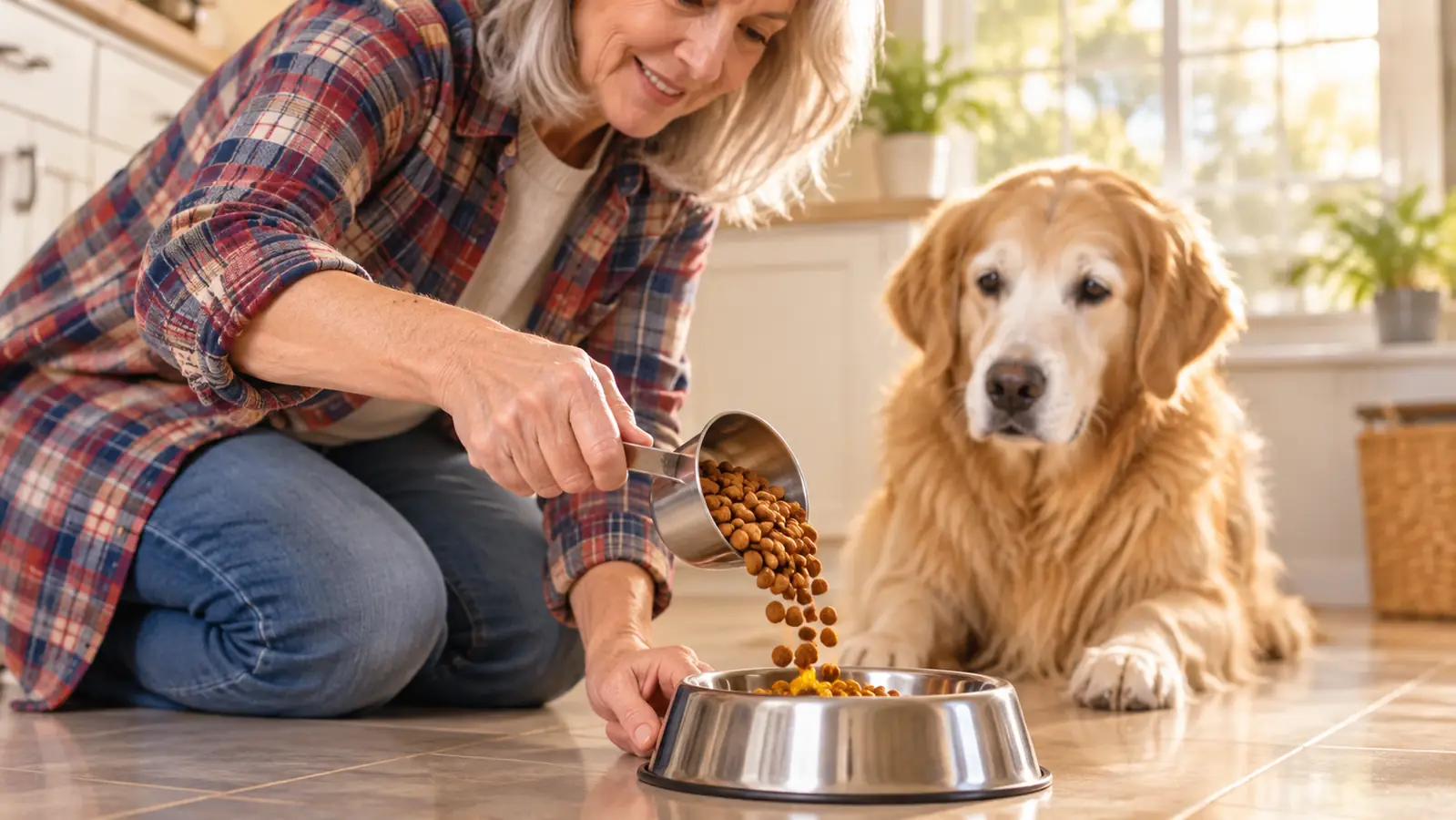
Breakfast is around seven, dinner around five, and I measure with a cup instead of eyeballing it. The amount comes off the bag and from a conversation with my vet. Over the first few months on this food, with measured portions and a longer morning walk, Juniper lost a few extra pounds and has stayed there. Carrying less weight is the kindest thing I can do for an older dog's joints. No food does that by itself. The measuring cup and the walking shoes do it.
LifeSource Bits, and her honest opinion of them
Blue Buffalo adds what they call LifeSource Bits, a blend of antioxidants, vitamins and minerals, mixed through the kibble as separate little pieces. Juniper eats around some of them, which I take to be a dog thing rather than a verdict. She gets them in the bowl either way. What I notice is a bright-eyed dog on a cold morning who still brings me a shoe when she wants a walk. I cannot credit a kibble bit for that. I can tell you she has eaten it twice a day for about a year and nine months without one refused meal.
A plain dry food she eats at a sensible speed
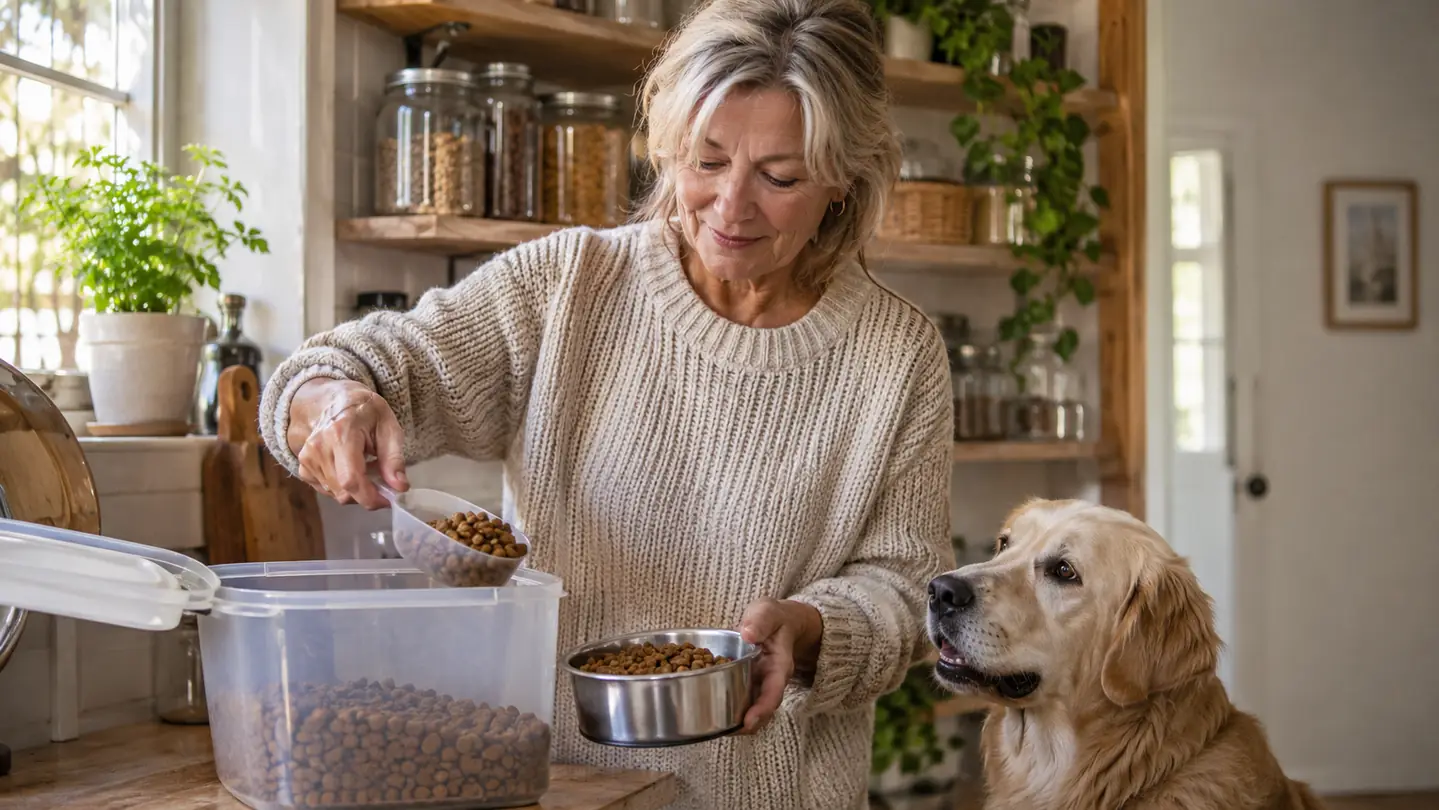
It is a dry pellet food, which suits a dog who used to inhale dinner in under a minute and sometimes bring it back up. That problem I solved with a slow feeder bowl about two and a half years ago, and she still eats both meals out of it. Between the plain kibble and the bowl, dinner takes her several minutes instead of seconds. I am not going to pretend I measured a piece of kibble with calipers, but a ten-year-old dog should not be wolfing her food, and this is easy to slow down.
Chicken and brown rice is a flavor she finishes
The bag I buy is chicken and brown rice, fifteen pounds. She licks the bowl every meal, and she is not a dog who licks bowls out of politeness. Same flavor for about a year and nine months, one bag roughly every three weeks. There is something to be said for boring. A dog with a sensitive stomach does better on the same food, in the same amount, at the same times, than on a rotation that interests me more than it interests her.
The bag size matches how we actually live
Fifteen pounds lasts Juniper about three weeks, which is a size I can carry in from the truck, pour into the storage container in one go, and forget about until the last scoop. The kibble lives in an airtight container in the pantry by the back door, on wheels, because mice got into a bag in the garage one winter and I am not doing that again. A bag that fits the container and the calendar turns out to matter every third week.
It is one less decision at ten
At four, I could feed Juniper almost anything and she would bounce off the walls. At ten, food is one of a set of decisions I make daily: the morning walk, the shorter evening one, the joint chewable at breakfast, the fish oil over her kibble, the yearly vet visit. Blue Buffalo Senior 7+ is the part I no longer think about. It is aimed at older dogs, she does well on it, and it is one decision I get to stop making twice a day.
What the bag says about joints, and what I actually rely on
The listing says this formula supports joint health in senior dogs, and that is what caught my eye in the first place. I will be straight with you: I do not believe a bag of kibble is what keeps an old dog moving. What keeps Juniper moving is her weight, her walks, and the joint supplement my vet suggested about two years ago. The food does its job by giving her what an older body needs twice a day and not working against her. That is a smaller promise than the front of the bag makes, and it is the honest one.
What I'd Skip
Two things I would skip. First, do not buy the biggest bag to start. If your dog has a sensitive stomach, buy the smaller one, mix it over ten days, and find out whether it works before you give up a pantry shelf to it. Second, do not expect the food to fix a limp. If your dog is stiff on cold mornings, that is a vet conversation, and food is one small piece of the answer alongside weight and movement. I would also skip free-feeding, which is how a dog puts on the extra weight that makes everything harder at ten. Measure the cup. Pick the bowl up between meals, or in Juniper's case, run it through the sink and set it back down at five.
She lost a few pounds in the first months on measured portions and has stayed there. That has done more for her cold mornings than anything printed on the front of a bag.
Juniper is ten. She is not the dog who ran the field behind the house at six, and no food is going to change that. But she gets up easier than she did two winters ago, she finishes both meals, and she still meets me at the door when the truck pulls in. Blue Buffalo Senior 7+ has been part of that for about a year and nine months, and I have no plans to change it.
If your dog is seven or older and the old food stopped fitting
This is the bag in my pantry, the one Juniper has eaten twice a day since February 2025. Start with a smaller bag, switch slowly, and ask your vet about anything medical.
Amazon Check Today's Price on Amazon →