
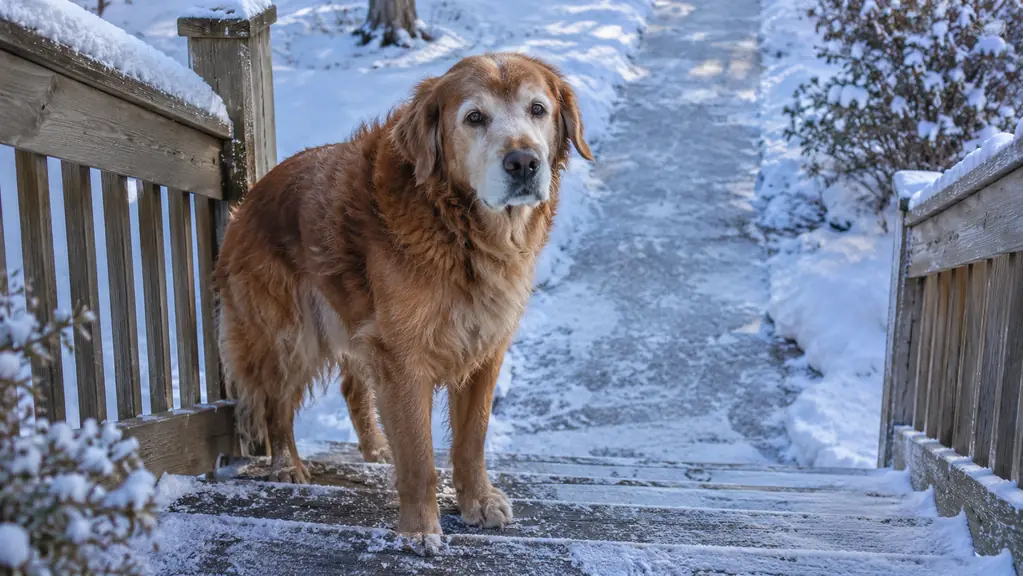
Juniper turned ten this fall. She is a Golden Retriever, about sixty-four pounds, with a muzzle that has gone nearly white and a firm opinion about mornings in November, which is: not yet.
The first cold snap is when I see it clearest. She stands at the top of the three back steps and considers them the way I consider a tax form. Then she takes them one at a time, slow, back end last. By the time we are forty feet down the driveway she is walking like herself again, and by the time we are back at the door she is ready for breakfast.
That gap, the dog at the top of the steps and the dog at the door, is the whole subject of this article. It is also the reason I started buying Cosequin chewable tablets from Nutramax Laboratories about two years ago, after my vet suggested a joint supplement was worth a try.
I am not a veterinarian and nothing here is medical advice. I am sixty-one, I live in a small house outside Bozeman, Montana, and I have done house sitting and pet sitting around this valley for about twelve years. Before that I managed a school cafeteria, which is where I learned to read every word on a label and to ignore the front of the package.
What follows is the routine I actually run from November through March, in the order I run it. Four of the five things cost nothing at all. The fifth is that chewable, and I will tell you plainly what I think it did and what it did not.
The tablet that goes on Juniper's kibble every morning
Cosequin chewable tablets from Nutramax Laboratories, 132 count, with glucosamine hydrochloride, sodium chondroitin sulfate and MSM on the label. It is one line in a five line routine, not the routine itself. Ask your own vet whether a joint supplement is worth trying before you start one.
Amazon Check Today's Price on Amazon →Five Things, In the Order I Do Them
Step 1: Write down one week of mornings before you change anything
The urge is to buy something on day one. I have done that. I once bought a bed for a stiff dog and it sat in the garage for two years because she preferred the floor by the woodstove. So before you spend anything, spend a week paying attention instead.
What I wrote on the back of an envelope on the kitchen counter: the time she got up, how long she stood still before she moved, which leg she favored if any, how far we got before her stride loosened up, the temperature, and whether the day before had been a rest day or a long one. Seven lines a day. Maybe four minutes of your life.
The pattern is usually obvious by Thursday. Juniper's turned out to be temperature and rest days, not distance. She was stiffer after a quiet Sunday than after a two mile Saturday, which told me I was dealing with stiffness from lying still rather than soreness from overdoing it. That one piece of information changed what I aimed at, and it cost me nothing but a week of noticing.
I kept that envelope going all winter, and I still keep a version of it now. It is how I know whether something is helping or whether I have simply gotten used to the walk. Memory is generous to things we have paid for.
Step 2: Warm her up inside before the door opens
Cold muscle does not like cold air. Ten minutes of moving around the house before the leash comes off the hook does more for Juniper than any piece of gear I have bought her, and I have bought some gear.
Nothing formal about it. I putter. I walk to the kitchen and back and she follows. I go down the hall to the bedroom and fold a load of laundry and she follows. I step out onto the porch and back inside and she follows. Two or three laps of a small house is all it takes for her to be walking with a normal stride by the time we reach the steps. On the mornings it is below zero I do it twice, and I do not apologize for the delay.
Do not stretch her. I mean that one. I have watched people take a stiff dog's back leg and pull it out straight, and the dog's face says everything you need to know. If she wants to stretch she will do it herself, front end down and back end up, and she will hold it exactly as long as she needs to. Your job is to give her the floor space and the ten minutes, not to do it for her.
Step 3: Fix the ground under her feet, not the dog
Montana in January is a skating rink with a view. A ten year old dog with a stiff back end is not built for ice, and no supplement in the world fixes glare.
So the driveway gets shoveled and then sanded, and I mean the full width, not a narrow little path down the middle. I keep a bucket by the door with a scoop in it. The back steps get a rough mat so she is not landing on polished wood. And we walk the plowed gravel shoulder instead of the field, even though she would much rather be in the field, because the field is where the crust is.
The other half of this is shorter and more often. One long cold walk is harder on her than three short ones. In deep winter we do twenty minutes in the morning and ten in the evening, and if the wind is coming down off the Bridgers we do the ten minutes twice around the block and call it done. She does not need the mileage. She needs to keep moving, and she needs me to not be a hero about it.
Then check her feet at the door. Ice balls packed between the pads are their own particular misery, and they are easy to miss when you are cold and thinking about coffee.

Step 4: Take the weight off the joints before you buy anything
Every extra pound on a dog is several pounds of load through the hips and knees. This is the least interesting advice in the article and it is the thing that has done the most for Juniper. I say that as a person who would almost always rather buy something.
I measure her kibble with an actual cup, level, twice a day, and I do not top up the bowl because she gives me the look. She eats Blue Buffalo Life Protection Senior 7+ and has for about a year and nine months. I moved her onto it over roughly ten days, mixing the old food with the new, because her stomach does not tolerate sudden changes. The amount is per the bag and per my vet, who I ask every year at her checkup.
Dinner goes into an Outward Hound Fun Feeder, the Drop pattern one, which has ridges molded into the bottom. That was not a joint decision at the time. She was inhaling dinner in under a minute and occasionally bringing it back up, and the bowl slowed her down to several minutes. The side effect is that she now spends that time standing and moving her head around instead of gulping and lying down, which is not nothing for a stiff dog.
The kibble itself lives in an IRIS USA container in the pantry, the one on wheels that holds up to fifty-four pounds, because mice got into a bag in the garage one winter. It has an airtight lid and I hand wash it between bags. That is not a joint tip. It is just the reason the food is where it is, and why the scoop is always in the same place.
Between measured portions and more walking, she lost a few extra pounds over her first months on the senior food. I could see her ribs again, which I had not been able to for a while. She moved better for it. That had nothing to do with a bottle or a tablet, and I think it is dishonest when people leave that part out.
I keep a note on the fridge from the first week of November, 2024: '8:10, three steps, about forty seconds.' The note this week says '8:05, fifteen seconds.' I will take it.
Step 5: Bring it to your vet, and know what a supplement can and cannot do
At Juniper's checkup the fall she turned eight, I mentioned the slow cold mornings. The vet watched her walk, went over her, and suggested a joint supplement was worth a try. That is the entire sum of my medical advice, and it came from someone with her hands on my actual dog. Ask yours before you start anything.
One distinction, because it matters more than the rest of this page. Stiff is slow to rise and loosens up as she moves. Limping is a dog who will not put weight on a leg, or who yelps, or who goes off her food, or who is suddenly worse on a Tuesday for no reason. The first one is what this article is about. The second one is a phone call to the vet the same day, not a supplement.
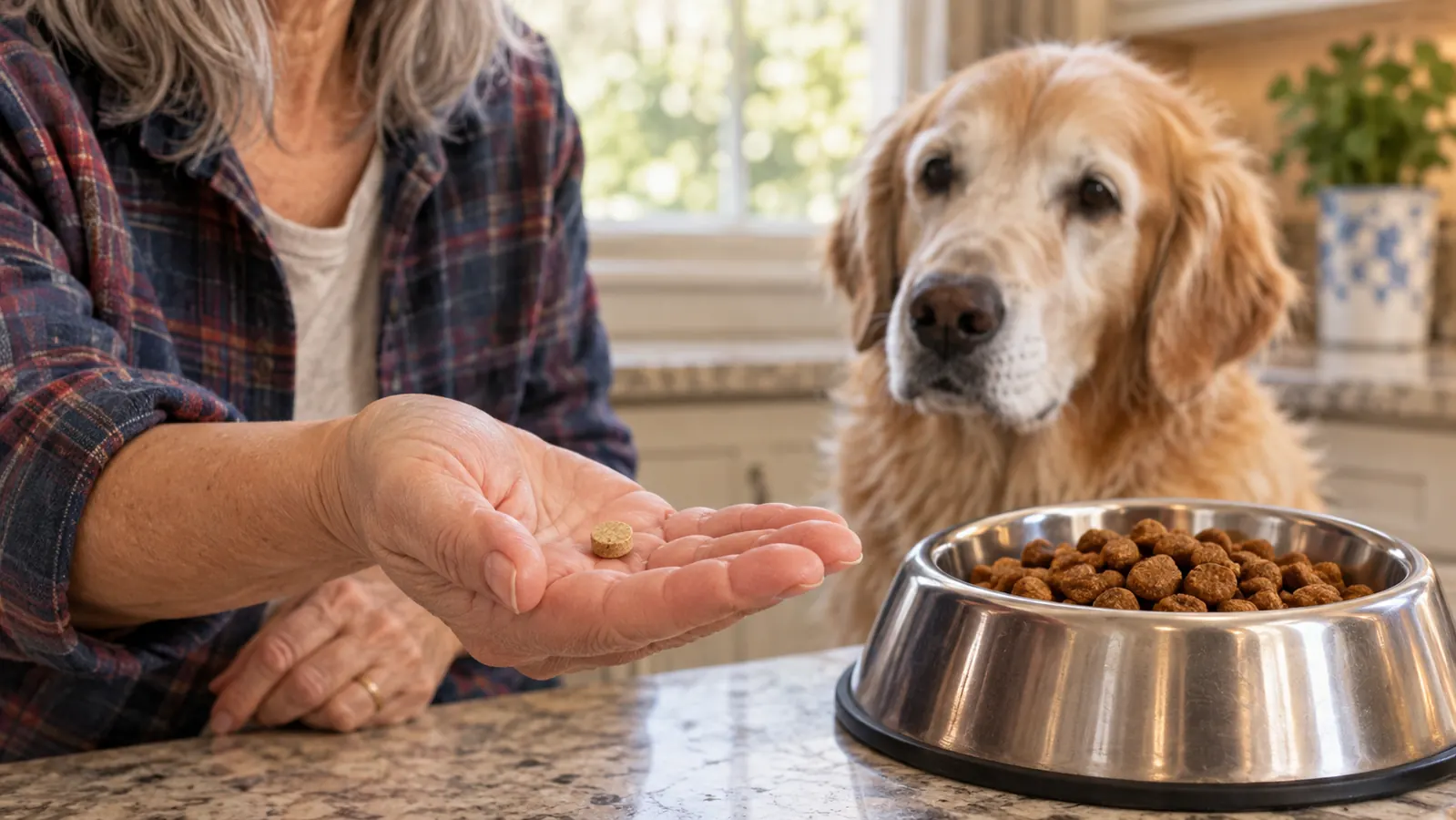
What I bought was Cosequin chewable tablets from Nutramax Laboratories. The label lists glucosamine hydrochloride, sodium chondroitin sulfate and MSM. It is a chewable tablet, which matters more than it sounds, because a tablet a dog will take as a treat at breakfast is a tablet that actually gets taken. The bottle we buy is 132 tablets. Juniper gets hers on top of her kibble, and the amount follows the label and my vet. I am not going to give you a number here, because your dog is not my dog and I am not a vet.
The package says it is the top vet recommended retail joint health supplement brand, and that Nutramax Laboratories has been in pet health for more than twenty-five years. That is the box talking, not me. I can only tell you about two years of watching one dog in one cold valley.
Here is the whole of my claim. She gets going a little easier on cold mornings than she did the winter before we started. That is it. I am not going to tell you it rebuilt anything, and I am not going to tell you it added a day to her life, because I do not know that and neither does anyone selling you something. Walks and keeping her weight down matter just as much, and I would say that if the tablets were free.
The honest cons, since you are about to spend money. It is a cost every month and I notice it. It took weeks before I thought I saw anything, and I may have been seeing what I wanted to see. It is not fast, and it is not dramatic. And if I had used it instead of the other four steps, I do not believe it would have done a thing. It is one line in a routine, not the routine.
The practical part: the bottle lives in the pantry next to the food container, so it is in my hand at the same moment every morning. A supplement you forget to give is a supplement that does not work. The habit is the hard part, not the tablet.
What Else Helps
A few more things that cost nothing or close to it. Keep the house a degree warmer overnight than you would for yourself, because a dog who has spent eight hours on a cold floor has to thaw out before she can walk, and you will feel that thaw in the first ten minutes of the morning. Dry her off at the door, especially the belly and the backs of the legs, since wet fur in a cold house is not doing her any favors. Give her somewhere warm to lie that is off the tile and out of the draft from the door. Juniper has a spot by the woodstove and she has opinions about anyone who blocks it.
Keep her nails short, too. Long nails change how a dog stands, and how she stands is what she walks on. It is a small thing that gets ignored for months at a time.
And do not change five things on a Monday. Pick one, run it for two weeks, then add the next. Otherwise you will never know which one helped, and you will be buying things forever on the strength of one good week. The first warm stretch in March will also fool you into dropping all of it. Do not. The cold comes back, and so does the stiffness.
If you take one thing from all of this, take the week of notes and the ten minutes of puttering before the door opens. Neither costs anything at all. Then call your vet, and then decide about a supplement with their input rather than mine.
Ask the vet first, then start the bottle
Cosequin chewable tablets from Nutramax Laboratories, 132 count, with glucosamine hydrochloride, sodium chondroitin sulfate and MSM. Juniper has had hers at breakfast for about two years. The other four steps in this article are free and they matter more.
Amazon Check Today's Price on Amazon →